In the world of fuel cells, the question is never “which one is the best?” — it is always “which one fits your mission best?” This article breaks down three major technological approaches: solid‑state metal hydride (paired with a PEMFC stack), PEMFC (using compressed hydrogen), and RMFC (reformed methanol fuel cell). We put solid‑state metal hydride first, because in many safety‑critical and volume‑constrained applications, it is the decisive factor.
What Is Solid‑State Metal Hydride + Fuel Cell?
Solid‑state metal hydride is not a fuel cell stack type by itself — it is a hydrogen storage technology that is paired with a PEMFC stack to form a complete power system. The principle is simple yet elegant: hydrogen atoms are absorbed into the crystal lattice of a metal alloy via chemical bonds, storing the gas at near‑ambient pressure (typically <5 bar) instead of the 350–700 bar required by conventional compressed‑gas tanks.
Why does this matter?
- Intrinsic safety — even under severe impact or puncture, the hydride releases hydrogen slowly rather than explosively.
- Exceptional volumetric density — metal hydrides can pack more hydrogen per unit volume than liquid hydrogen or compressed gas at 700 bar.
- Low‑pressure operation — no high‑pressure compressors or heavy carbon‑fibre tanks are needed, reducing both system weight and cost.
When coupled with a PEMFC stack, the hydride releases hydrogen upon gentle heating (often using waste heat from the fuel cell itself), delivering a steady stream of pure H₂ to the membrane electrode assembly. The output power is determined by the PEMFC stack, while the energy storage capacity is governed by the hydride canister.
Positioning: If you need maximum safety and volumetric energy density in a portable or mobile application, solid‑state metal hydride is your first choice.
→ Learn more about HYDRA‑M: our solid‑state metal hydride fuel cell systems.
What Is PEMFC?
The Proton Exchange Membrane Fuel Cell (PEMFC) is the most commercially mature fuel cell technology. It runs on pure hydrogen (from a high‑pressure tank, pipeline, or reformer) and converts chemical energy directly into electricity via a proton‑conducting membrane, operating at 60–80°C. The main strengths are high power density, fast cold‑start capability, and excellent scalability — from a few watts to over 200 kW. That is why PEMFC is the dominant choice for fuel‑cell electric vehicles and many stationary power systems.
Positioning: If you require high power output, rapid dynamic response, and zero tailpipe emissions, PEMFC is the proven workhorse.
→ Explore HYDRA‑G: our high‑pressure hydrogen PEMFC systems.
What Is RMFC?
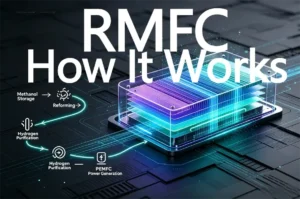
The Reformed Methanol Fuel Cell (RMFC) is a PEMFC variant with an integrated fuel processor. It starts with liquid methanol (CH₃OH) and water — fuels that are easy to store, transport, and refill using existing liquid‑fuel infrastructure. The reformer converts methanol into a hydrogen‑rich gas via steam reforming, which is then fed into a high‑temperature PEMFC (HT‑PEMFC) that tolerates trace amounts of CO in the reformate. RMFC bypasses the methanol crossover and catalyst poisoning issues of direct methanol fuel cells, while liberating users from hydrogen supply chain constraints.
A key safety note: the fuel is a 50% methanol‑water mixture with significantly reduced flammability compared to pure methanol — an important distinction for transport and on‑site storage in remote or tactical environments.
Positioning: If you are off‑grid and need convenient fuel replenishment without relying on hydrogen pipelines or high‑pressure refuelling stations, RMFC is the natural answer.
→ See HYDRA‑R: our reformed methanol fuel cell systems.
Input Fuel → Core Reaction → Output Power
| Technology Route | Input Fuel | Core Reaction / Process | Power Range | Best For |
|---|---|---|---|---|
| Solid‑State Metal Hydride + PEMFC | Metal hydride canister (low‑pressure solid storage) | Hydride releases H₂ upon heating → PEMFC generates electricity | Determined by PEMFC stack (1 W – 100 kW+) | Missions where safety and volumetric density are paramount |
| PEMFC | Pure hydrogen (compressed gas or pipeline) | H₂ → 2H⁺ + 2e⁻ (anode); O₂ + 4H⁺ + 4e⁻ → 2H₂O (cathode) | 1 W – 100 kW (scalable to MW) | Applications demanding high power density and fast response |
| RMFC | 50% methanol‑water mixture | Steam reforming → H₂‑rich gas → HT‑PEMFC generation | 25 W – 5 kW (expandable) | Off‑grid, remote sites where hydrogen infrastructure is unavailable |
Decision Matrix: Power Level × Mission Environment
Selecting the right fuel cell technology is a two‑dimensional decision — power requirements and mission environment.
| Power Level | Typical Application | Recommended Technology | Core Rationale |
|---|---|---|---|
| <60W | Sensors, IoT, micro‑power devices | Solid‑State Metal Hydride + low‑power PEMFC | Safe at low pressure, compact, ideal for embedded systems |
| 60W – 500W | Soldier‑portable power, small UAVs, handheld devices | Solid‑State Metal Hydride + low‑power PEMFC | Safe at low pressure, compact footprint, ideal for man‑packed systems |
| 500W – 5kW | Drones, border outposts, off‑grid telecom base stations | RMFC (if refuelling is difficult) / Solid‑State Hydride + PEMFC (if safety is top priority) | RMFC offers easy methanol replenishment; hydride gives inherent safety |
| 5kW – 50kW | Telecom base stations, backup power, light vehicles | PEMFC (if pure hydrogen is available) / RMFC (if hydrogen access is limited) | PEMFC provides high power density; RMFC removes dependence on pipeline hydrogen |
| 50kW – 205kW+ | Heavy‑duty trucks, buses, stationary generation | PEMFC | Highest power density, mature supply chain, excellent load‑following capability |
PEMFC covers an extremely wide power band — from 1 W to over 100 kW — making it the universal choice for transportation (cars, ships, drones), stationary CHP, and backup power. For heavy trucks and buses, a PEMFC system often requires 100–175 kW, while sub‑10 kW stacks suit drones and portable power.
RMFC shines in the 25 W – 5 kW mobile and off‑grid segment. In 5G telecom base stations, kW‑class methanol reformers have demonstrated 3.02 kW output with 47.2% system efficiency in real‑world trials. RMFC is widely adopted for field communications, scientific expeditions, and soldier power.
Solid‑state metal hydride storage is a cross‑cutting enabler — it can be mated with any PEMFC stack regardless of power rating. In portable military applications and onboard vehicular storage, metal hydrides are preferred for their inherent safety, respectable gravimetric density, and superior volumetric density versus compressed gas.
→ Compare head‑to‑head data in our fuel cell comparison center.
Key Trade‑Offs: Three Core Dilemmas
Every engineering choice involves trade‑offs. Here are the three most critical dimensions.
1. Energy Density vs. Safety
PEMFC (compressed hydrogen):
- High gravimetric energy density, but 700‑bar tanks introduce significant safety hazards and volumetric inefficiencies. The tank itself is heavy and bulky.
RMFC (methanol):
- Methanol has higher volumetric energy density than compressed hydrogen and stores at ambient pressure. The 50% methanol‑water mixture has significantly reduced flammability, though handling protocols remain necessary.
Solid‑state metal hydride:
- The volumetric hydrogen density is the highest among all storage methods, and operation at ambient pressure makes it intrinsically safe — even under severe collision or fire, the hydride releases hydrogen slowly and is resistant to explosive release. The trade‑off is weight — the metal alloy canisters are heavier, and system‑level gravimetric targets typically aim for >2 wt% H₂.
Verdict: Solid‑state hydride leads on safety, but you must accept a weight penalty. Compressed hydrogen offers high energy density with greater risk; RMFC sits between them.
2. Fuel Replenishment Convenience vs. Purity Requirements
PEMFC demands high‑purity hydrogen — contaminants like CO severely poison the platinum catalyst. Refuelling relies on hydrogen stations or cylinder swaps, and infrastructure is the main bottleneck.
RMFC leverages existing liquid‑fuel logistics — methanol can be distributed through the same networks as gasoline and diesel, eliminating expensive hydrogen refuelling stations. However, the reformate gas contains trace CO, requiring a high‑temperature PEMFC or additional purification.
Solid‑state metal hydride: Canisters are factory‑charged and shipped to the field; after use, they can be returned for recharging or recharged on‑site at low pressure. Replenishment convenience lies between PEMFC and RMFC.
Verdict: RMFC offers the greatest fuel‑supply convenience, especially in remote areas without hydrogen pipelines.
3. Cost vs. Service Life
PEMFC relies on platinum‑group metals, driving up initial cost. However, the technology is mature, economies of scale are reducing costs, and stack lifetimes can reach tens of thousands of hours.
RMFC is the most complex system — reformer, heat exchangers, and HT‑PEMFC stack. Start‑up time is longer (typically 17–45 minutes), and system efficiency ranges from 28.5% to 40%. But the fuel (methanol) is cheap and widely available.
Solid‑state metal hydride: The hydride materials are costly, and thermal management of the canister adds system complexity. However, the heat required for hydrogen desorption can be supplied by the fuel cell’s waste heat, improving overall system efficiency.
Verdict: PEMFC has high upfront cost but proven long‑term operation; RMFC is complex but has low fuel cost; solid‑state hydride has higher material cost but exceptional safety and volumetric advantages.
→ Run the numbers: 5‑Year TCO: Fuel Cells vs Diesel vs Lithium
How SOLIDHYDRO Fits In
SOLIDHYDRO’s three product lines directly map to these technology architectures, with solid‑state metal hydride as our foundational expertise:
- HYDRA‑M — Solid‑state metal hydride storage plus a PEMFC stack. For applications where safety and volumetric density are mission‑critical: man‑portable power, small drones, handheld devices, and any mission demanding low‑pressure hydrogen.
- HYDRA‑R — Our RMFC solution, integrating a methanol reformer with a high‑temperature PEMFC. Ideal for hydrogen‑poor, off‑grid environments: border outposts, remote telecom sites, and field camps that need easy fuel resupply.
- HYDRA‑G — A pure PEMFC system running on compressed hydrogen. Tailored for high‑power, fast‑response applications: heavy‑duty trucks, stationary generators, large UAVs, and backup power where hydrogen infrastructure is available.
Our engineering team provides cross‑technology consulting — we don’t push a single solution. Instead, we evaluate your mission profile: power demand, operating environment, fuel availability, safety constraints, and total cost of ownership. From system architecture and thermal optimisation to fuel‑supply logistics and on‑site deployment, our engineers accompany you through every phase.
Next Steps
Not sure which technology fits your mission? Three simple actions:
- Clarify your core requirements — What is your power level? Is your site urban, remote, or maritime? Is hydrogen readily available?
- Visit our product pages — Go to /products/ for detailed specifications of HYDRA‑M, HYDRA‑R, and HYDRA‑G.
- Request a technical consultation — Submit your application scenario via /contact/. Our engineering team responds within 24 business hours with a preliminary technology recommendation.
Every fuel cell technology has its own sweet spot. Finding yours is half the success — and we’re here to help you find it.
Further reading
- Solid‑State Metal Hydride: The Standard for Safe Field Power
- 60W Man‑Portable Power: What Modern Field Operations Actually Demand
- From 45 Minutes to 8 Hours: How Hydrogen PEMFC Breaks the UAV Endurance Barrier
- ¼ the Fuel Cost: How Methanol Reforming Transforms Off‑Grid Power Economics
- The Third Path: Why Hydrogen PEMFC Outperforms BEV for Heavy‑Duty Logistics
- BVLOS UAV Power: The Complete Propulsion Selection Guide
- -40°C Survival: Which Power Source Actually Works?
- 5‑Year TCO: Fuel Cells vs Diesel vs Lithium for Off‑Grid Power
- Silent Power: How ≤45dB Fuel Cells Redefine Field Operations
- Explore All SOLIDHYDRO Products
- View Blog Archive