The cost challenge of off‑grid power is deceptively simple: the equipment isn’t expensive — but running it is.
When a power source is shipped to a remote base station, border outpost, or island site, the purchase price is just the beginning. Fuel transport, maintenance labour, downtime losses — every category steadily eats into the budget.
HYDRA‑R, a reformed methanol fuel cell (RMFC), changes the equation. Fuel cost at approximately ¼ of gasoline, silent operation, near‑zero thermal signature, and methanol available in virtually every country.
This is not incremental improvement. This is a fundamental simplification.
The Real Cost of Diesel
Diesel itself isn’t expensive. What is expensive is getting it to where it’s needed.
A diesel generator at 75% load consumes approximately 0.27 litres of diesel per kWh. At remote mining sites, agricultural operations, or coastal facilities — where fuel is trucked over unpaved roads or barged to island locations — logistics push delivered costs to $0.50–$0.80/kWh. By comparison, grid‑connected industrial power in most markets runs at just $0.08–$0.15/kWh.
The gap is even wider in practice. In remote operations, diesel logistics premiums range from 30% to 80% of the delivered price. A mid‑sized mining operation running three 500kW generators continuously consumes approximately 340 litres per hour. At a delivered price of $1.20/litre, fuel alone exceeds $3.5 million annually.
Extreme cases are even more revealing. On Queensland’s K’gari Island, diesel prices have surged to $4.25/litre — against a mainland Australian average of approximately $2.84/litre. In remote regions like Sabah, logistics costs can be two to three times higher due to multi‑stage transport and last‑mile delivery.
And that’s just the fuel. Diesel generators require oil, filter, and belt changes every 250–500 hours. At remote sites, dispatching a technician often costs more than the maintenance itself.
The true cost of diesel is never on the fuel station price tag — it’s hidden in logistics, maintenance, and downtime.
Methanol’s Logistics Advantage
Now compare methanol.
Methanol is a globally traded commodity. It is not a specialty fuel requiring dedicated supply chains. From Asia to the Americas, from Europe to Africa — methanol is available in virtually every country.
Global methanol prices declined approximately 15% in 2025, from $0.39/kg to $0.33/kg. The 2026 forecast range is $0.33–$0.42/kg. CFR China main port prices stand at approximately $415/tonne, with FOB Rotterdam at approximately $456/tonne.
But the logistics advantage goes deeper.
HYDRA‑R uses a 50% methanol‑water blend. This dilution significantly reduces flammability compared to pure methanol — safer to transport and store on‑site. A single operator can carry enough fuel for days of runtime in sealed cartridges. No heavy equipment. No special training. No hazardous goods shipping fees.
Why RMFC Outperforms DMFC
In the methanol‑fuelled power space, Direct Methanol Fuel Cells (DMFC) exist as an alternative. DMFC feeds liquid methanol directly into the stack for electrochemical reaction. Simpler in concept — but fundamentally flawed in practice.
Problem 1: Methanol Crossover
In DMFC, methanol molecules cross the proton exchange membrane from anode to cathode, reacting directly with oxygen and generating parasitic current. This not only wastes fuel but creates a “mixed potential” that dramatically reduces cell voltage and efficiency. The academic consensus is clear: methanol crossover is the single greatest technical barrier to DMFC commercialisation.
Problem 2: Catalyst Poisoning
Methanol that crosses to the cathode poisons the platinum catalyst, causing rapid performance degradation and shortened stack life. Studies show significantly higher degradation rates for DMFC in the presence of methanol.
Problem 3: Real‑World Efficiency Far Below Theoretical
DMFC’s theoretical efficiency is 96.7% — but actual performance is severely limited by crossover and voltage losses. Commercially available DMFC systems show 40% power degradation in approximately 3,000 hours.
How HYDRA‑R (RMFC) Solves These Problems
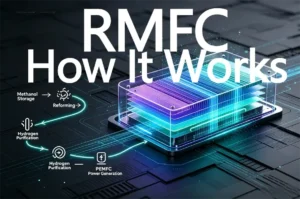
RMFC does not feed methanol directly into the stack. Instead, a reformer converts methanol into hydrogen‑rich gas, which is then fed to a high‑temperature PEMFC (HT‑PEMFC) stack.
- No methanol crossover: The stack receives hydrogen‑rich gas, not liquid methanol — crossover is simply non‑existent
- No catalyst poisoning: The stack operates in a hydrogen‑rich environment — catalyst poisoning does not occur
- Higher efficiency: RMFC system efficiency reaches 28.5–46% — far exceeding DMFC’s real‑world performance
- Longer life: No catalyst poisoning means stack life is significantly longer than DMFC
| Dimension | Diesel | DMFC | HYDRA‑R (RMFC) |
|---|---|---|---|
| Fuel form | Liquid, requires tank | Liquid, proprietary cartridges | Liquid, sealed cartridges |
| Fuel cost | High + logistics premium | High (proprietary) | Approximately ¼ of gasoline |
| Stack fuel | Combustion | Liquid methanol (direct) | Hydrogen‑rich gas (post‑reform) |
| Methanol crossover | N/A | ❌ Severe, unavoidable | ✅ Non‑existent |
| Catalyst poisoning | N/A | ❌ Methanol poisons Pt catalyst | ✅ Non‑existent |
| Real‑world efficiency | 33–38% | Far below theoretical | 28.5–46% |
| Stack life | 250–500h service | ~40% degradation at 3,000h | Significantly longer |
| Supply chain | Dedicated network | Proprietary cartridges | Globally traded commodity |
| Best for | Fixed / mobile | Portable / mobile | Fixed / semi‑mobile |
| Thermal signature | High | Moderate | Near‑zero |
| Noise | 70–85dB | Moderate | ≤45dB |
For man‑portable applications requiring maximum mobility: HYDRA‑M, with solid‑state metal hydride storage delivering >1200Wh/kg energy density, is the superior choice.
TCO Comparison: 5‑Year View
Here is a 5‑year TCO breakdown for a typical off‑grid communication site:
| Cost Category | Diesel Generator | DMFC | HYDRA‑R (RMFC) |
|---|---|---|---|
| Equipment (CapEx) | 8,000–8,000–15,000 | 5,000–5,000–8,000 | Higher |
| Fuel cost (5 years) | 20,000–20,000–30,000+ | High (proprietary cartridges) | Approximately ¼ of diesel |
| Fuel transport (5 years) | 6,000–6,000–24,000+ (30–80% premium) | Moderate (cartridge shipping) | Very low (globally traded) |
| Maintenance / stack replacement (5 years) | 5,000–5,000–15,000+ | High (replacement at ~3,000h intervals) | Minimal (no moving parts) |
| Downtime / interruption | High | Moderate | Very low |
| 5‑Year Total TCO | 40,000–40,000–80,000+ | 30,000–30,000–50,000+ | Significantly lower |
In a real‑world case from July 2026, Guangzhou Power Supply Bureau’s methanol‑hydrogen backup power project completed an off‑grid trial. Data showed that compared to conventional diesel generators, the system achieved approximately 50% lower levelised cost of electricity (LCOE) and over 40% reduction in carbon emissions.
RMFC system efficiency ranges from 28.5–46%. A comparative study confirmed PEMFC maintained stable efficiency of approximately 27% across various load conditions, outperforming diesel generators.
On a 5‑year horizon, HYDRA‑R’s total cost of ownership is significantly lower than diesel generators — and far superior to DMFC.
→ See the full comparison: RMFC vs Diesel Generator
Operational Scenarios
Off‑Grid Communication Base Stations
Requirement: 24/7 stable power, 8,760 hours/year Challenge: Long diesel delivery lead times, high maintenance, outage risk
HYDRA‑R advantages:
- Fuel cartridges can be stockpiled — no frequent resupply needed
- No moving parts — maintenance is minimal
- Remote monitoring — no on‑site staffing required
- Silent operation — does not interfere with sensitive equipment
Border Outposts and Fixed Surveillance Posts
Requirement: Low‑power long‑duration operation, fixed‑location covert deployment Challenge: Diesel generator noise and thermal signature reveal position
HYDRA‑R advantages:
- ≤45dB silent operation — acoustically undetectable
- Near‑zero thermal signature — invisible to thermal imaging
- 24/7 autonomous operation — no human intervention required
- A single cartridge set supports weeks to months of runtime
Disaster Response and Emergency Power
Requirement: Rapid deployment, instant power, silent operation Challenge: Diesel generators are loud, emit fumes, and start slowly
HYDRA‑R advantages:
- Deploy and go — no installation or commissioning
- ≤45dB silent operation — does not disrupt relief efforts
- Zero diesel emissions — suitable for ventilated indoor spaces
- Methanol cartridges can be air‑dropped or rapidly resupplied by vehicle
One Cartridge, One Mission
HYDRA‑R’s fuel resupply logic is remarkably straightforward:
| Aspect | Detail |
|---|---|
| Time | 5–10 minutes for cartridge swap |
| Labour | Single operator, no tools, no training |
| Form | Sealed cartridges, no cold chain or special storage |
| Continuity | No shutdown — hot‑swap during operation |
| Cost | Fuel at approximately ¼ of gasoline |
For fixed outposts and base stations, this means dramatically simplified logistics. No more waiting for diesel deliveries, stockpiling bulk fuel, or worrying about fuel degradation or leaks. Cartridges can be integrated into the regular supply chain like any other consumable — energy replenishment in minutes, not hours.
When dedicated HYDRA-M solid‑state metal hydride supply chains are unavailable and budget is constrained, HYDRA‑R offers a third path: globally available methanol, single‑operator resupply, and reliable off‑grid power. A single HYDRA‑R 60W system, paired with cartridges a single operator can carry, supports days of off‑grid mission runtime.
It is not as lightweight as HYDRA‑M — methanol cartridges carry 3–4× the weight of solid‑state metal hydride for the same energy — but it is significantly lighter than diesel (approximately ⅓–½ the weight of a diesel generator + fuel for the same energy), far quieter (≤45dB vs 70–85dB), and dramatically simpler (5–10 minute single‑operator swap vs pump‑and‑pour plus specialist handling). For operators with limited budgets who need to move away from diesel, HYDRA‑R is a compelling alternative.
→ Explore HYDRA‑M solid‑state metal hydride systems
Conclusion: The Full Lifecycle Cost Is What Matters
A diesel generator’s purchase price looks cheap. But running it for five years costs several times the purchase price — often ten times or more.
DMFC appears simple, but methanol crossover and catalyst poisoning drive real‑world efficiency far below theoretical values, limit stack life, and inflate long‑term operating costs.
HYDRA‑R offers a fundamentally different answer for off‑grid power:
- Fuel cost at approximately ¼ of diesel
- Globally traded commodity — no regional supply chain constraints
- Minimal maintenance — no moving parts, stack life significantly longer than DMFC
- ≤45dB silent operation — suitable for more mission types
- Near‑zero thermal signature — ideal for covert deployment
- 5–10 minute cartridge swap — no shutdown required
- LCOE reduced by approximately 50% compared to diesel, based on real‑world trial data
Off‑grid power cannot be evaluated on unit price alone — full lifecycle cost is what matters. When you factor in transport, maintenance, downtime, and signature requirements, HYDRA‑R is not just the cleaner choice — it is the more economical, more flexible, and quieter choice.
For higher‑power off‑grid applications (>50kW): HYDRA‑G 120kW high‑pressure hydrogen for industrial‑scale outpost and base station power. For extreme mobility: HYDRA‑M with >1200Wh/kg energy density for man‑portable and vehicle‑mounted applications.
Continue reading: