
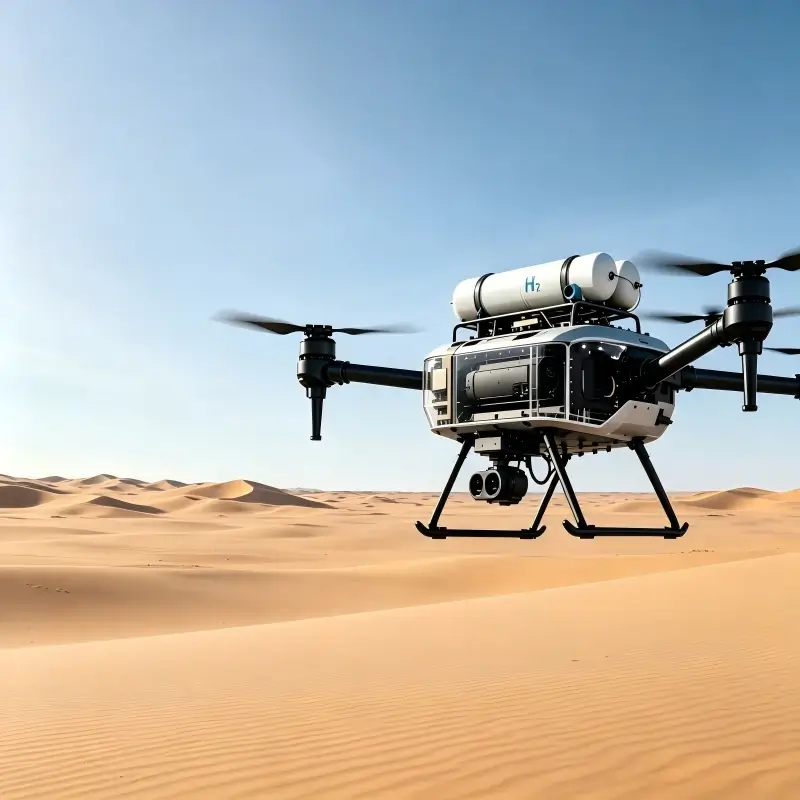
HYDRA-G 3.3kW Air-Cooled PEM Fuel Cell for UAVs

Air-cooled PEM fuel cell for UAVs, delivering 3.3kW of rated power in a ≤7.65kg system with native 48V DC output, high power density and cold-start capability down to -40°C.

Designed for long-endurance UAVs, VTOL and BVLOS applications where lightweight continuous power and efficient system integration are critical.For a broader overview of UAV hydrogen power architectures, see ours UAV Hydrogen Fuel Cell Solutions.

HYDRA-G 3.3kW Air-Cooled PEM Fuel Cell Advantages

Lightweight Design for Long-Endurance UAVs

With a system weight of ≤7.65kg, HYDRA-G 3.3kW is designed for weight-sensitive UAV platforms where system mass directly affects payload capacity and flight endurance. The lightweight architecture helps UAV designers balance fuel-cell power, hydrogen storage, battery capacity and payload requirements.

Native 48V DC Output

Native 48V DC output supports integration with compatible UAV power architectures, helping reduce the need for additional voltage-conversion stages and simplify system integration.

Low Noise and Low Vibration

The air-cooled PEM fuel cell architecture is designed for low acoustic and vibration output, making HYDRA-G 3.3kW suitable for UAV platforms where noise, vibration and system weight are important design considerations.

Simplified Air-Cooled Architecture

The air-cooled architecture eliminates the need for a conventional liquid-cooling loop, pump and radiator, helping reduce system complexity and cooling-system weight for mobile applications.

3.3kW PEM Fuel Cell Technology for UAVs & Light Mobility

HYDRA-G 3.3kW is designed around the weight, power and integration requirements of UAVs and lightweight mobile platforms. For long-endurance UAV applications, system weight is a critical design factor because it affects payload capacity, hydrogen storage and overall flight endurance.

Low-Pressure Hydrogen Supply for UAV Applications

HYDRA-G 3.3kW operates with hydrogen supplied at 100–120 kPa.g, supporting integration with suitable low-pressure hydrogen storage systems or compatible hydrogen-generation solutions. This low-pressure operating architecture can simplify hydrogen-system integration for suitable UAV applications compared with systems designed around high-pressure hydrogen supply.
 

Cold-Start Capability Down to -40°C

HYDRA-G 3.3kW is designed with cold-start capability down to -40°C under specified operating conditions, supporting UAV applications that may operate in demanding low-temperature environments. Final cold-weather performance depends on the complete UAV power system, hydrogen supply, battery and operating conditions.
 

47% Rated Electrical Efficiency

With a rated electrical efficiency of 47%, HYDRA-G 3.3kW converts hydrogen into electrical power for long-duration UAV and mobile applications. Actual system-level efficiency and hydrogen consumption depend on operating power, system configuration and operating conditions.

HYDRA-G 3.3kW Applications for Long-Endurance UAVs

Long‑Endurance UAVs

HYDRA-G 3.3kW is designed for long-endurance UAV missions such as infrastructure inspection, surveying, remote-area monitoring and other applications requiring sustained onboard electrical power.
For a detailed approach to UAV endurance and system integration, see our UAV Hydrogen Fuel Cell Endurance & Integration Guide.

VTOL & BVLOS Hydrogen Fuel Cell Power

HYDRA-G 3.3kW is designed for suitable VTOL and BVLOS UAV architectures where extended endurance, continuous onboard power and low system weight are important design requirements.
For UAV propulsion architecture considerations, see our BVLOS UAV Propulsion Selection Guide.

Light EV & Micro-Mobility Fuel Cell Power

The compact air-cooled architecture can also support e-bikes, delivery robots, autonomous mobile platforms and other lightweight electric mobility applications requiring compact continuous power.

HYDRA-G 3.3kW vs. Batteries and Other Fuel Cell Technologies

FeatureHYDRA‑G 3.3kW (Air‑Cooled PEMFC)DMFC (Direct Methanol)High‑Capacity Li‑Ion
Power Density >2kW/kg (stack) 0.5kW/kg 150–250 Wh/kg
Dynamic Response Instant Slow (methanol crossover lag) Instant
System Weight ≤7.65kg 12–18kg >25kg (equiv. energy)
Refuel / Recharge <5 min (H₂ swap) 5–10 min (cartridge) 1–4 hours
Cold Weather -40°C stable -20°C to -32°C Reduced performance at low temperatures
Acoustic Signature Near silent (≤45dB) Quiet Silent
Emissions Zero (H₂O) Ultra‑low Zero (local)
Maintenance Minimal (air‑cooled) Cartridge replacement Degradation over cycles

Performance varies by system configuration and operating conditions. Direct comparisons should be made using equivalent power, energy, environmental and test conditions.

HYDRA-G 3.3kW PEM Fuel Cell Specifications

ParameterValue
Model HYDRA‑G 3.3KW
Technology PEMFC (Air‑Cooled)
Rated Power 3.3 kW (Configurable 1–8kW)
Output Voltage 48 VDC (Native)
System Weight ≤7.65 kg
Dimensions (L*H*W) 336 × 324 × 180 mm
Stack Power Density >2.0 kW/kg
Rated Efficiency 47%
Design Life >2,000 h
Operating Temp -40°C to +40°C
Hydrogen Pressure 100–120 kPa.g (Low‑Pressure)
Cooling Method Air‑Cooled (Open‑Cathode)
Protection Rating IP54 (Customizable)

Specifications may vary depending on system configuration and application requirements. Contact SOLIDHYDRO for the latest technical specifications and UAV integration support.

Frequently Asked Questions

Q: What are the primary applications for the HYDRA-G 3.3kW fuel cell?
A: HYDRA-G 3.3kW is designed primarily for long-endurance multirotor UAVs, VTOL and BVLOS platforms, as well as selected lightweight electric mobility applications such as delivery robots and autonomous mobile platforms requiring continuous power.
A: Air cooling reduces system weight and complexity by eliminating the conventional liquid-cooling loop, pump, radiator and coolant. This makes the architecture suitable for UAVs and other weight-sensitive mobile platforms where compact integration and simplified thermal management are important.
A: Yes. HYDRA-G can be configured for different power requirements, with options from 1kW to 8kW per module depending on system configuration. Custom firmware and control parameters can also be developed for specific UAV power requirements and operating conditions.
A: HYDRA-G 3.3kW operates with low-pressure hydrogen supplied at 100–120 kPa.g and can integrate with suitable lightweight hydrogen storage systems or compatible hydrogen-generation equipment. Final storage selection depends on flight endurance, payload, pressure regulation and aircraft configuration.
A: HYDRA-G 3.3kW provides native 48V DC output for integration with compatible UAV power architectures. The final electrical configuration should be evaluated together with the motor controller, battery, power-management system and other onboard electrical components.
A: Yes. HYDRA-G 3.3kW can be integrated into a hybrid fuel cell and battery power architecture, with the fuel cell providing continuous or base electrical power while the battery supports peak and transient loads such as takeoff, climb and acceleration. The final power-management strategy should be matched to the UAV’s propulsion system and flight profile.
A: HYDRA-G 3.3kW is designed for suitable UAV architectures that require extended endurance, including potential BVLOS applications. Whether a specific UAV can support BVLOS operations depends on the aircraft configuration, propulsion system, energy system, communications, flight-control system and applicable regulatory requirements.

Power Your Next-Generation UAV with HYDRA-G 3.3kW

Talk to our engineers about UAV integration, flight-profile requirements, hydrogen system sizing and fuel cell + battery power architecture.

Talk to SOLIDHYDRO

Need technical information, product specifications or application support? Contact our engineering team.

Whatsapp

+86 19813722676

Socials

Click or drag files to this area to upload.You can upload up to 5 files.