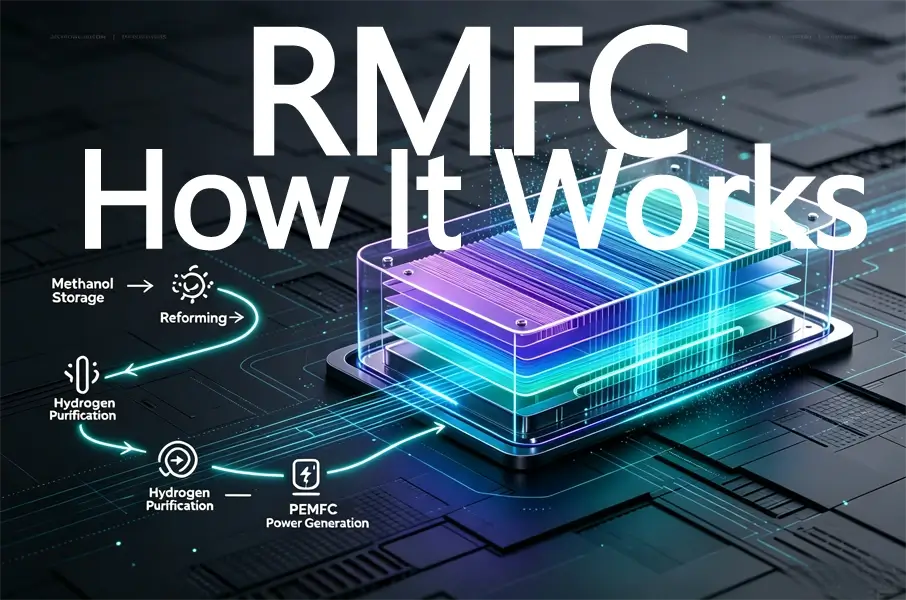
A Reformed Methanol Fuel Cell (RMFC) is a fuel-cell power system that converts liquid methanol into hydrogen and then uses that hydrogen to generate electricity through a proton exchange membrane fuel cell (PEMFC).
Unlike a conventional hydrogen fuel cell that requires hydrogen to be stored in a high-pressure cylinder, an RMFC system stores energy in liquid methanol and produces hydrogen on demand through an integrated reformer.
This architecture combines the high energy density and easy handling of liquid fuel with the clean and efficient electricity generation of a hydrogen fuel cell.
For portable, tactical, remote and off-grid applications, RMFC technology can provide a practical alternative to batteries, diesel generators and conventional high-pressure hydrogen systems.
What Is a Reformed Methanol Fuel Cell?
A Reformed Methanol Fuel Cell (RMFC) is a fuel-cell system in which methanol is first converted into a hydrogen-rich gas through a catalytic reforming process.
The resulting hydrogen is then supplied to a PEM fuel cell stack, where it reacts electrochemically with oxygen from the air to produce electricity.
The overall process can be simplified as:
Methanol → Hydrogen-Rich Gas → PEM Fuel Cell → Electricity
This is fundamentally different from a Direct Methanol Fuel Cell (DMFC).
In a DMFC, methanol is supplied directly to the fuel-cell stack and participates in the electrochemical reaction.
In an RMFC, methanol is first processed by a reformer to produce hydrogen. The hydrogen is then consumed by a conventional PEM fuel-cell stack.
This separation allows RMFC systems to take advantage of the mature performance characteristics of PEM fuel-cell technology while using methanol as a convenient liquid energy carrier.
How Does an RMFC Work?
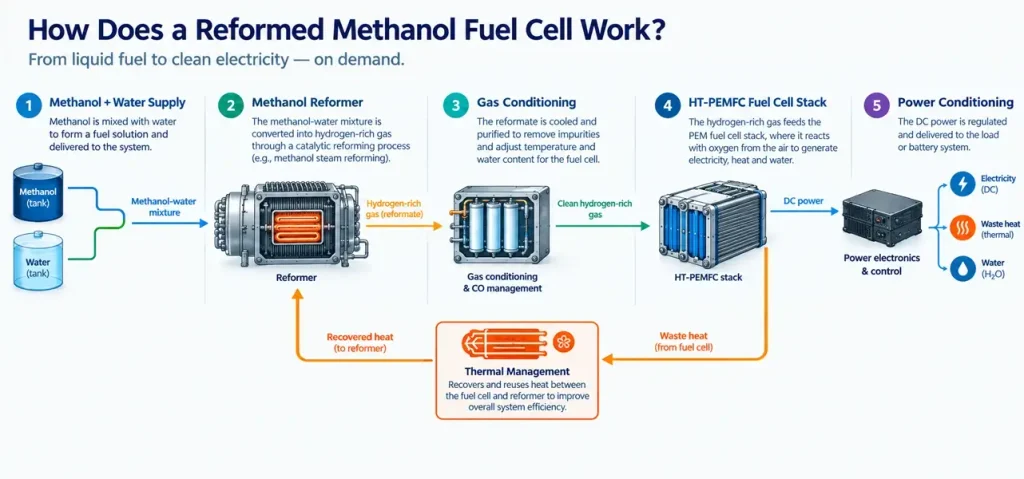
An RMFC system typically consists of several integrated components:
- Methanol fuel tank
- Fuel delivery system
- Methanol reformer
- Gas purification system
- PEM fuel cell stack
- Air supply system
- Thermal management system
- Power conditioning and control electronics
Together, these components continuously convert methanol into electrical power.
Step 1: Methanol Storage
The process begins with liquid methanol stored in a fuel container.
Unlike compressed hydrogen, methanol can be stored as a liquid at ambient conditions without a high-pressure hydrogen cylinder.
This simplifies fuel handling, transportation and refueling for many portable and remote applications.
For field systems, this can be particularly useful because the operator can carry additional liquid fuel and refuel the system when required.
Step 2: Methanol Reforming
The methanol is delivered to a reformer, where it is converted into a hydrogen-rich gas.
A simplified methanol steam-reforming reaction can be represented as:
CH₃OH + H₂O → CO₂ + 3H₂
In a practical RMFC system, the reformer operates together with controlled heat and catalytic materials to produce hydrogen efficiently.
The reformer is therefore one of the most important components of an RMFC system.
Its job is to continuously produce hydrogen from methanol at the rate required by the fuel-cell stack.
Step 3: Gas Purification
The reformate gas produced by the reformer contains hydrogen along with other gases, including carbon dioxide and potentially trace amounts of carbon monoxide.
Because PEM fuel-cell catalysts are sensitive to carbon monoxide, the reformate must be appropriately conditioned and purified before entering the fuel-cell stack.
The exact purification architecture depends on the system design, operating temperature and reforming technology.
Effective gas cleanup is critical to maintaining fuel-cell performance, efficiency and long-term durability.
Step 4: Hydrogen Enters the PEM Fuel Cell
The purified hydrogen-rich gas is supplied to the anode side of the PEM fuel-cell stack.
Inside the fuel cell, hydrogen is separated into protons and electrons.
The proton exchange membrane allows protons to pass through while forcing the electrons to travel through an external electrical circuit.
That flow of electrons generates useful electrical power.
Step 5: Oxygen Comes From Ambient Air
At the cathode side, oxygen from the surrounding air participates in the electrochemical reaction.
The overall PEM fuel-cell reaction is:
2H₂ + O₂ → 2H₂O + Electricity + Heat
The primary electrochemical products are therefore electricity, water and heat.
This is why the fuel-cell stack itself does not produce the particulate emissions and combustion gases associated with a conventional diesel generator.
Step 6: Electricity Is Delivered to the Load
The electricity generated by the PEM fuel-cell stack is then regulated through power electronics and supplied to the connected equipment.
Depending on the system, the output can be used to power:
- Portable electronics
- Communications equipment
- Sensors
- UAV systems
- Robotics
- Remote monitoring equipment
- Field equipment
- Backup power systems
- Off-grid electrical loads
The system can also be designed to operate continuously as long as sufficient methanol is available.
RMFC vs. Direct Methanol Fuel Cell
RMFC and DMFC are both methanol-based fuel-cell technologies, but their architectures are fundamentally different.
| Feature | RMFC | DMFC |
|---|---|---|
| Fuel | Methanol | Methanol |
| Hydrogen generation | Internal reformer | No external reforming stage |
| Fuel-cell stack | Typically PEMFC | Direct methanol fuel-cell stack |
| Hydrogen used by stack | Yes | No |
| System complexity | Higher | Lower |
| Fuel processing | Required | Not required |
| Potential power density | High, depending on design | Generally lower |
| Main advantage | Combines liquid fuel with hydrogen PEMFC technology | Simple direct methanol architecture |
The key difference is simple:
DMFC uses methanol directly in the fuel cell. RMFC converts methanol into hydrogen first.
For applications where higher power density, PEMFC performance and longer-duration operation are important, RMFC can offer significant advantages.
Why Use Methanol to Produce Hydrogen?
At first glance, producing hydrogen from methanol may seem unnecessary when hydrogen can be supplied directly.
The answer is fuel storage and logistics.
Hydrogen has excellent gravimetric energy characteristics, but storing large quantities of hydrogen can require compressed-gas cylinders, specialized infrastructure or other hydrogen-storage technologies.
Methanol, by contrast, is a liquid fuel that can be stored and transported using established liquid-fuel logistics.
An RMFC therefore shifts the challenge from storing hydrogen to generating hydrogen on demand.
This can be particularly attractive when:
- Long operating time is required
- Refueling must be fast
- High-pressure hydrogen infrastructure is unavailable
- The power system must remain compact
- Fuel transportation is an important consideration
- The system is deployed in remote or off-grid environments
RMFC vs. Hydrogen Fuel Cell
A conventional hydrogen PEM fuel-cell system typically follows this architecture:
Compressed Hydrogen → PEM Fuel Cell → Electricity
An RMFC system follows:
Liquid Methanol → Reformer → Hydrogen → PEM Fuel Cell → Electricity
Both systems ultimately use hydrogen electrochemistry inside the PEM fuel-cell stack.
The major difference is how hydrogen is supplied.
Conventional Hydrogen Fuel Cell
A direct hydrogen system offers a relatively simple energy-conversion path because hydrogen is already available for the fuel-cell stack.
However, the system requires an appropriate hydrogen supply and storage solution.
Reformed Methanol Fuel Cell
An RMFC integrates hydrogen generation into the power system.
This eliminates the need to carry compressed hydrogen as the primary fuel and allows the operator to replenish the system with liquid methanol.
For certain field applications, this can simplify fuel logistics and increase operational flexibility.
Advantages of RMFC Technology
1. Liquid Fuel Storage
Methanol can be stored as a liquid under ordinary conditions, making it easier to handle than compressed hydrogen in many operating environments.
2. Hydrogen Generated On Demand
The system produces hydrogen internally as required by the fuel-cell stack.
This eliminates the need for a separate high-pressure hydrogen supply in the field.
3. PEM Fuel Cell Performance
Because the reformate hydrogen is supplied to a PEM fuel-cell stack, RMFC systems can benefit from the high efficiency and low-temperature electrochemical operation associated with PEMFC technology.
4. Long-Duration Operation
The operating duration can be extended by carrying additional liquid fuel rather than relying solely on a fixed battery capacity.
This makes RMFC technology particularly interesting for missions requiring extended endurance.
5. Low Acoustic Signature
Fuel cells generate electricity electrochemically rather than through combustion.
When properly engineered, an RMFC system can therefore operate with a much lower acoustic signature than conventional internal-combustion generators.
6. Reduced Local Air Pollutants
Because electricity is generated through an electrochemical process rather than combustion, RMFC systems can avoid the high levels of particulate matter, NOx and other combustion-related pollutants typically associated with diesel generators.
However, methanol reforming itself produces CO₂, so RMFC systems should not be described as completely carbon-free.
Limitations and Engineering Challenges
RMFC technology is not without challenges.
Reformer Start-Up Time
The reformer must reach its operating condition before hydrogen production becomes stable.
This means an RMFC may have a longer start-up process than a battery.
Thermal Management
Methanol reforming requires controlled thermal conditions.
The system must manage the heat generated and consumed by the reformer, fuel cell and supporting components.
Gas Purification
PEM fuel cells require clean hydrogen.
Controlling carbon monoxide and other reformate impurities is therefore essential for stack performance and durability.
System Integration
An RMFC is more complex than a simple battery because it combines fuel storage, reforming, gas treatment, thermal management, fuel-cell conversion and power electronics.
The engineering challenge is to integrate these components into a compact, reliable and efficient system.
Where Are RMFC Systems Used?
RMFC technology is particularly relevant to applications where long endurance, compact fuel logistics and reliable off-grid power are more important than the instant start-up capability of a battery.
Potential applications include:
Tactical and Military Power
Soldiers and field teams may need continuous electrical power for communications, sensors, computing and other electronic equipment.
An RMFC can provide extended power without relying solely on large battery packs.
UAV and Robotics
For selected UAV and robotic platforms, the ability to carry liquid fuel and generate electricity over extended periods can provide an alternative to conventional battery-only architectures.
The actual suitability depends on payload, system weight, required power, mission profile and thermal requirements.
Remote and Off-Grid Power
RMFC systems can provide electrical power where grid access is unavailable or unreliable.
Potential applications include remote monitoring stations, telecommunications equipment, scientific instruments and field infrastructure.
Backup and Emergency Power
Because the system can be refueled with liquid methanol, RMFC technology can also be considered for extended backup-power applications where battery runtime alone is insufficient.
RMFC vs. Batteries
Batteries are highly efficient and provide excellent instant power, but their operating time is directly linked to stored electrical energy.
Once the battery is depleted, the system must be recharged or the battery must be replaced.
An RMFC stores energy in liquid fuel and converts that fuel into electricity continuously.
This creates a different operating model:
Battery: Charge → Operate → Recharge
RMFC: Refuel → Operate → Refuel
For short missions, batteries can remain the most practical solution.
For longer missions where carrying additional fuel is easier than carrying additional battery capacity, RMFC technology can become increasingly attractive.
RMFC vs. Diesel Generators
Diesel generators remain widely used for high-power off-grid applications, but they rely on combustion engines and require mechanical components such as engines, alternators and exhaust systems.
RMFC systems generate electricity electrochemically.
This can provide advantages in:
- Acoustic signature
- Local air quality
- Mechanical complexity
- Part-load efficiency, depending on system design
- Compact portable power applications
However, diesel generators remain highly competitive for applications requiring very high continuous power, rapid startup and established fuel infrastructure.
The best technology therefore depends on the mission profile rather than a single universal metric.
The Role of RMFC in Next-Generation Portable Power
The development of RMFC technology reflects a broader trend in distributed power generation:
moving from storing electricity to storing energy in a transportable fuel and converting it into electricity when needed.
Batteries store electrical energy directly.
Hydrogen fuel cells store hydrogen and convert it electrochemically.
RMFC systems take a different approach by using methanol as the energy carrier and generating hydrogen internally.
This architecture can bridge the gap between liquid-fuel logistics and hydrogen fuel-cell power generation.
For tactical, remote and long-duration applications, that combination can be particularly valuable.
SOLIDHYDRO HYDRA-R: Compact RMFC Power
SOLIDHYDRO applies RMFC technology to compact power systems designed for demanding portable and off-grid applications.
The HYDRA-R Series uses methanol reforming to generate hydrogen for a PEM fuel-cell system, providing an alternative to conventional battery-only power architectures.
The HYDRA-R 60W system is designed for applications where compact size, low acoustic output, extended runtime and convenient liquid-fuel refueling are important.
Instead of carrying compressed hydrogen, the system uses methanol as its primary fuel and generates hydrogen internally.
This approach is particularly relevant to portable equipment, remote power and tactical applications where fuel logistics and endurance are critical.
Conclusion
A Reformed Methanol Fuel Cell (RMFC) combines two technologies:
methanol reforming + hydrogen PEM fuel cells.
The reformer converts liquid methanol into a hydrogen-rich gas. After purification, the hydrogen is supplied to a PEM fuel-cell stack, where it reacts with oxygen from the air to generate electricity.
The result is a power architecture that combines the liquid-fuel logistics of methanol with the electrochemical power generation of hydrogen fuel cells.
For applications requiring extended endurance, low acoustic output, portable operation and off-grid power, RMFC technology offers an alternative to conventional batteries, direct methanol fuel cells and combustion generators.
As fuel-cell systems continue to become smaller, lighter and more integrated, reformed methanol fuel cells may play an increasingly important role in next-generation portable and distributed power systems.
Explore SOLIDHYDRO HYDRA-R
Looking for a compact Reformed Methanol Fuel Cell (RMFC) solution for portable, tactical or off-grid power?
Explore the SOLIDHYDRO HYDRA-R Series — a methanol-reforming fuel-cell platform designed to generate hydrogen on demand and deliver reliable electrical power without relying on high-pressure hydrogen cylinders.
Explore HYDRA-R 60W →
Contact SOLIDHYDRO for Your Application →
Further Reading