Introduction
A methanol fuel cell is a fuel-cell power system that uses methanol as its primary fuel. Depending on the architecture, methanol can either be converted directly into electricity through a direct methanol fuel cell (DMFC) or first converted into hydrogen and then used by a PEM fuel cell in a reformed methanol fuel cell (RMFC) system.
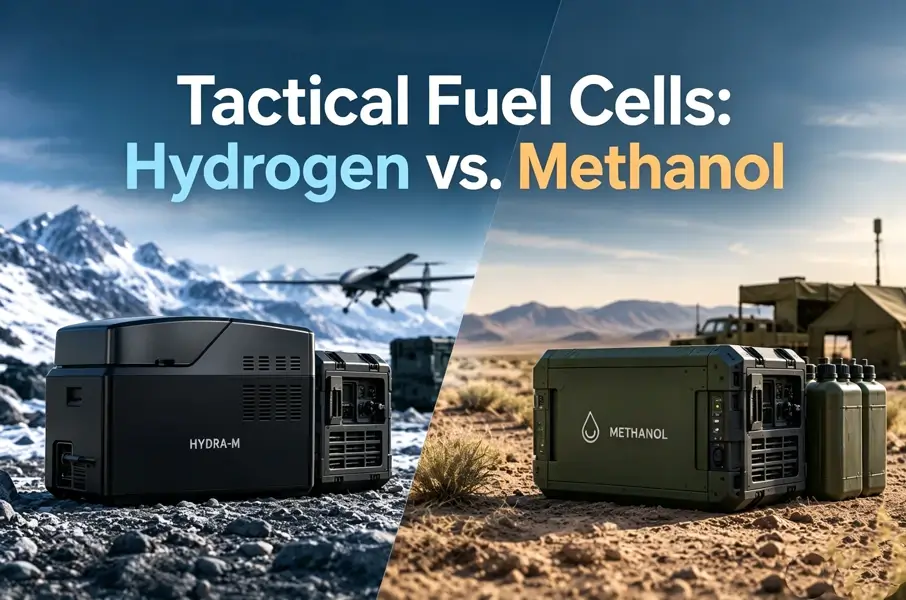
Methanol fuel cells are an important option for portable and tactical power, particularly where liquid-fuel logistics are already established. Hydrogen fuel cells offer a different pathway, with advantages in electrical efficiency, energy density, and low-pressure hydrogen storage when solid-state metal hydride technology is used.
For tactical and off-grid applications, the choice between a methanol fuel cell and a hydrogen fuel cell depends on energy density, fuel logistics, acoustic and thermal signatures, operating temperature, refueling time, reliability, and mission duration.For a broader overview of tactical hydrogen fuel cell architectures and field-power applications, see our Tactical Hydrogen Fuel Cell Solutions.
This article compares methanol fuel cells, including direct methanol fuel cells (DMFCs), with solid-state hydrogen fuel cell systems across the key criteria that matter for tactical and off-grid power.
What Is a Methanol Fuel Cell?
A methanol fuel cell generates electricity using methanol as the primary fuel.
A methanol fuel cell is a fuel cell system that uses methanol as an energy carrier to generate electricity. Two major architectures are commonly discussed: direct methanol fuel cells (DMFCs), which electrochemically use methanol at the anode, and reformed methanol fuel cells (RMFCs), which convert methanol into hydrogen-rich reformate before feeding it to a PEM fuel cell.
DMFCs simplify the fuel pathway by using methanol directly in the electrochemical stack. RMFC systems add a reformer and gas-conditioning stage, but can combine liquid-fuel logistics with the higher electrical conversion characteristics of a hydrogen-fed PEM fuel cell.
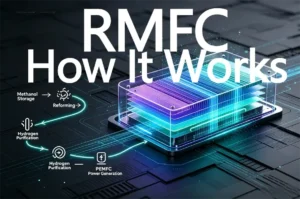
For a detailed explanation of methanol reforming and RMFC system architecture, see our guide: Reformed Methanol Fuel Cell (RMFC): How It Works.
DMFC vs. RMFC: What Is the Difference?
Direct Methanol Fuel Cell (DMFC)
A DMFC supplies liquid methanol directly to the anode of the fuel-cell stack.
The main advantage is architectural simplicity: no separate external hydrogen cylinder or onboard hydrogen storage system is required.
However, direct methanol systems face several technical challenges.
Methanol crossover can occur when methanol passes through the membrane from the anode toward the cathode. This can reduce fuel utilization and contribute to performance losses.
Other considerations include:
- Lower electrical efficiency than many hydrogen PEMFC systems
- Methanol crossover
- Water management requirements
- Catalyst and membrane performance
- Performance degradation during extended operation
DMFC technology can still be attractive where liquid-fuel availability and simple fuel storage are important.
Reformed Methanol Fuel Cell (RMFC)
An RMFC takes a different approach.
Instead of sending methanol directly into the electrochemical stack, the system first converts methanol into hydrogen through an integrated reforming process.
The hydrogen-rich gas is then supplied to a PEM fuel cell stack to generate electricity.
This architecture can provide several advantages:
- Higher electrical efficiency than typical DMFC architectures
- Reduced direct methanol crossover
- Better fuel utilization
- Liquid-fuel storage and transportation
- Hydrogen PEM fuel-cell conversion
- Long-duration autonomous operation
For remote and off-grid applications, RMFC can therefore offer a practical compromise between methanol logistics and hydrogen fuel-cell efficiency.
Methanol Fuel Cell vs. Solid-State Hydrogen Fuel Cell
Methanol and hydrogen fuel cells should not be compared only by the fuel itself.
The complete system matters.
This includes fuel storage, fuel conversion, fuel-cell efficiency, balance-of-plant components, thermal management, transportation, maintenance and mission duration.
1. Energy Density
Energy density is one of the most important parameters for portable and tactical power.
Every additional kilogram carried into the field affects mobility, endurance and logistics.
Solid-state hydrogen systems combine metal hydride hydrogen storage with PEM fuel-cell conversion. Depending on the material, system configuration and operating conditions, this architecture can provide high system-level energy density.
For example, SOLIDHYDRO’s HYDRA-M architecture is designed around more than 1,200 Wh/kg under its specified system configuration.
Methanol contains substantial chemical energy, but the amount of usable electrical energy depends strongly on the conversion architecture.
DMFC systems generally have lower electrical conversion efficiency than hydrogen PEMFC systems.
RMFC systems can improve this by converting methanol into hydrogen before power generation.
Tactical implication:
For long-duration missions, system-level energy density and fuel efficiency can have a major effect on total mission weight.
For a more focused discussion of tactical fuel battery architectures, see our Tactical Fuel Battery guide.
2. Fuel Logistics
Fuel logistics can determine whether a power system is practical outside controlled environments.
Methanol has an important advantage: it is a liquid fuel with established production, distribution and storage infrastructure.
This can make methanol attractive for remote deployments where liquid-fuel resupply is already available.
However, methanol is toxic and flammable, so transportation, storage and handling require appropriate safety procedures.
Solid-state hydrogen takes a different approach.
Instead of transporting conventional high-pressure hydrogen cylinders, hydrogen is stored within a metal hydride material.
This can reduce dependence on high-pressure gas storage and simplify hydrogen handling at the point of use.
Tactical implication:
Methanol benefits from established liquid-fuel logistics, while solid-state hydrogen can simplify point-of-use hydrogen storage and handling.
3. Electrical Efficiency
Electrical efficiency determines how much usable electricity can be produced from the available fuel.
Hydrogen PEM fuel cells generally provide higher electrical efficiency than direct methanol fuel cells.
DMFC systems must directly electrochemically process methanol, which introduces additional losses such as methanol crossover.
RMFC systems take another route by reforming methanol into hydrogen before the fuel-cell stack.
SOLIDHYDRO’s HYDRA-R system currently targets more than 35% system efficiency, compared with approximately 20–25% for typical direct methanol systems, subject to configuration and operating conditions.
Tactical implication:
For missions lasting many hours or days, higher electrical efficiency can reduce fuel consumption and resupply requirements.
4. Acoustic Signature
Low noise can be critical for surveillance, communications, observation and other sensitive operations.
Unlike combustion generators, fuel cells generate electricity electrochemically rather than through an internal combustion process.
This can significantly reduce acoustic output.
However, the final acoustic signature depends on the complete system, including:
- Pumps
- Fans
- Compressors
- Cooling systems
- Valves
- Balance-of-plant components
SOLIDHYDRO’s HYDRA-M and HYDRA-R systems are specified at approximately ≤45 dB under stated configurations and operating conditions.
Tactical implication:
Both hydrogen and methanol fuel-cell architectures can provide a major acoustic advantage over conventional diesel generators.
5. Thermal Signature
Fuel cells do not rely on combustion to generate electricity, but that does not mean they produce zero heat.
Every fuel-cell system must reject waste heat.
Actual thermal performance depends on:
- Electrical load
- Fuel-cell efficiency
- Cooling architecture
- Ambient temperature
- Insulation
- Heat rejection
- System enclosure
Hydrogen PEMFC and methanol fuel-cell systems can both operate at substantially lower temperatures than conventional combustion generators.
However, the complete system must be evaluated when thermal observability matters.
Tactical implication:
Fuel-cell technology can reduce thermal output compared with combustion generators, but no complete power system should be described as thermally invisible.
6. Fuel Storage and Operating Pressure
Hydrogen is often associated with high-pressure cylinders.
However, that is not the only way to store hydrogen.
Solid-state metal hydride technology stores hydrogen within a solid material and can operate at much lower pressure than conventional compressed-hydrogen storage. SOLIDHYDRO’s HYDRA-M Series applies this solid-state metal hydride architecture to portable and tactical power applications.
HYDRA-M is designed around near-ambient-pressure hydrogen storage.
Methanol is naturally stored as a liquid at ambient pressure.
Therefore, both technologies can avoid the need for conventional high-pressure hydrogen cylinders, but they solve the storage problem in different ways.
Tactical implication:
- Methanol → liquid fuel at ambient pressure
- Solid-state hydrogen → hydrogen chemically stored in metal hydride
- Compressed hydrogen → high-pressure gas storage
The correct choice depends on the complete mission and logistics system.
7. Runtime and Long-Duration Operation
For extended missions, initial power output is only part of the equation.
Fuel utilization and electrical efficiency become increasingly important as runtime increases.
Hydrogen PEM fuel cells can provide high electrical efficiency, making them attractive for long-duration operation.
DMFC systems face additional electrochemical challenges such as methanol crossover and water management.
RMFC systems can improve fuel utilization by converting methanol into hydrogen before the PEM fuel-cell stack.
This makes RMFC particularly relevant to long-duration autonomous power.
Tactical implication:
For multi-day missions, engineers should evaluate total fuel consumption and system efficiency rather than simply comparing the energy content of the fuels.
8. System Weight
System weight is especially important for portable and tactical applications.
For short-duration missions, the weight of the power unit itself may dominate.
For longer missions, fuel weight becomes increasingly important.
A fuel-cell system with higher electrical efficiency can require less fuel to deliver the same amount of usable electricity.
For solid-state hydrogen systems, the total mission weight depends on:
- Fuel-cell power level
- Metal hydride material
- Cartridge design
- Fuel quantity
- Duty cycle
- Mission duration
- Balance-of-plant components
The correct comparison should therefore use complete system weight plus fuel for the actual mission profile.
Tactical implication:
The lighter system at zero fuel is not necessarily the lightest system after 24, 48 or 72 hours of operation.
9. UAV and Remote Power Integration
Fuel cells can support UAV operations without necessarily being carried directly onboard the aircraft.
A ground-based fuel-cell system can provide continuous electrical power for battery charging in remote operating locations.
This allows the UAV battery to be optimized for flight while the ground power system handles longer-duration energy supply.
Both hydrogen and methanol fuel cells can support this architecture.
The choice depends on:
- Flight duration
- Number of sorties
- Battery recharge requirements
- Fuel availability
- Transport requirements
- Site mobility
- Resupply frequency
Tactical implication:
For UAV operations, the best fuel-cell architecture should be evaluated across the entire flight-and-recharge cycle rather than by flight endurance alone.
10. Extreme-Temperature Operation
Extreme temperatures can significantly affect portable power systems.
Cold environments can create challenges involving:
- Startup
- Water management
- Membrane performance
- Fuel delivery
- Thermal management
- Battery performance
HYDRA-M systems are designed for operation across demanding temperature conditions, including approximately -40°C under specified conditions.
HYDRA-R is specified for approximately -40°C to +50°C, subject to system conditions.
For methanol fuel cells, the freezing point of methanol itself is only one consideration. The complete fuel-cell system still has to manage water, membranes and startup conditions.
Tactical implication:
Cold-weather performance should always be evaluated at the complete-system level.
Methanol Fuel Cell vs. Solid-State Hydrogen: Comparison Table
| Parameter | Solid-State Hydrogen Fuel Cell | DMFC | RMFC |
|---|---|---|---|
| Primary fuel | Hydrogen | Methanol | Methanol |
| Power conversion | PEMFC | Direct methanol electrochemistry | Methanol reforming + PEMFC |
| Fuel storage | Metal hydride | Liquid methanol | Liquid methanol |
| Storage pressure | Near-ambient / low pressure | Ambient | Ambient |
| Electrical efficiency | High PEMFC efficiency | Typically lower | Higher than typical DMFC |
| Methanol crossover | No | Yes | Reduced because methanol is reformed |
| Fuel logistics | Dedicated hydrogen cartridges | Liquid-fuel logistics | Liquid-fuel logistics |
| Acoustic output | Low | Low | Low |
| Long-duration potential | High | Moderate | High |
| UAV support | Yes | Yes | Yes |
| Remote/off-grid power | Yes | Yes | Yes |
| Cold-weather performance | System-dependent; HYDRA-M designed for approx. -40°C | System-dependent | System-dependent; HYDRA-R designed for approx. -40°C to +50°C |
| Main advantage | High efficiency + solid-state hydrogen storage | Simple direct methanol architecture | Liquid-fuel logistics + PEMFC architecture |
How to Choose the Right Fuel Cell for a Tactical Mission
There is no single fuel-cell architecture that is optimal for every mission.
The right choice depends on mission duration, fuel availability, transport requirements, power level and environmental conditions.
Choose Solid-State Hydrogen When:
- High system-level energy density is important
- Long mission duration is required
- Low acoustic output is important
- Rapid cartridge replacement is preferred
- Near-ambient-pressure hydrogen storage is desirable
- Cold-weather operation is required
- High electrical efficiency is a priority
- UAV ground charging or remote power is required
- Point-of-use carbon emissions need to be minimized
Choose a Methanol Fuel Cell When:
- Liquid-fuel logistics are already established
- Methanol is readily available
- Ambient-pressure liquid storage is preferred
- Long-duration operation is required
- Fuel transportation infrastructure is based around liquid fuels
- The mission prioritizes fuel availability and logistics flexibility
Choose RMFC When:
- Methanol logistics are preferred
- Higher electrical efficiency than typical DMFC systems is desired
- Long-duration autonomous operation is important
- A PEM fuel-cell architecture is preferred
- Remote infrastructure requires extended unattended operation
HYDRA-R: Reformed Methanol Fuel Cell for Long-Duration Power
For applications where methanol logistics are attractive but higher fuel-cell efficiency is required, reformed methanol fuel cell (RMFC) technology provides another option.
SOLIDHYDRO’s HYDRA-R uses an integrated methanol reforming process to generate hydrogen on demand before supplying the hydrogen to a PEM fuel-cell stack.
This architecture is designed for long-duration off-grid and remote power applications, including telecom infrastructure, security systems, industrial applications and selected UAV power scenarios.
The HYDRA-R platform currently includes a 60W configuration, with additional power variants under development. Its published specifications include a target system efficiency above 35%, ≤45 dB acoustic output and operation from approximately -40°C to +50°C.
If your application requires methanol-based fuel logistics with hydrogen PEM fuel-cell conversion, explore the HYDRA-R platform:
Explore HYDRA-R Reformed Methanol Fuel Cell Systems →
Why Methanol Fuel Cells Remain Relevant
Methanol remains an attractive fuel for distributed and remote power because it is a liquid fuel with established handling and distribution infrastructure.
For some deployments, transporting and storing liquid methanol may be easier than establishing a dedicated hydrogen supply chain.
However, the term “methanol fuel cell” covers different technologies.
A DMFC and an RMFC should not be treated as the same system.
DMFCs use methanol directly in the electrochemical stack, while RMFC systems convert methanol into hydrogen before power generation.
This distinction is especially important when evaluating:
- Electrical efficiency
- Fuel utilization
- Runtime
- Maintenance
- Stack life
- Fuel consumption
- Mission logistics
For long-duration remote power, the complete system architecture may matter more than the fuel name itself.
Why Solid-State Hydrogen Is Emerging in Tactical Power
Solid-state hydrogen storage provides an alternative to conventional compressed-hydrogen storage.
Instead of transporting hydrogen as a high-pressure gas, metal hydride materials store hydrogen within a solid medium.
When integrated with a PEM fuel-cell stack, this creates a power architecture that can provide:
- High electrical efficiency
- Low acoustic output
- Near-ambient-pressure hydrogen storage
- Rapid cartridge replacement
- Long-duration operation
- Low point-of-use emissions
- Wide operating-temperature capability
These characteristics make solid-state hydrogen particularly relevant to tactical power, UAV support, remote monitoring, communications and expeditionary operations.
Frequently Asked Questions About Methanol Fuel Cells
What is a methanol fuel cell?
A methanol fuel cell is a fuel-cell system that uses methanol as its primary fuel. The two major architectures are direct methanol fuel cells (DMFCs) and reformed methanol fuel cells (RMFCs).
What is the difference between DMFC and RMFC?
A DMFC uses methanol directly in the fuel-cell stack. An RMFC first reforms methanol into hydrogen and then uses a PEM fuel cell to generate electricity.
Is a methanol fuel cell better than a hydrogen fuel cell?
Not universally. Methanol can offer advantages in fuel availability and liquid-fuel logistics, while hydrogen PEM fuel cells generally offer higher electrical efficiency. The best choice depends on mission duration, fuel logistics, weight, operating conditions and system requirements.
Are methanol fuel cells suitable for long-duration power?
Yes. Methanol fuel cells can be used for long-duration power, particularly in remote and off-grid applications. RMFC architectures are especially relevant where long runtime and liquid-fuel logistics are important.
Is RMFC more efficient than DMFC?
An RMFC can achieve higher system efficiency than typical direct methanol fuel-cell systems because methanol is converted into hydrogen before entering the PEM fuel-cell stack. Actual performance depends on system architecture and operating conditions.
Can methanol fuel cells be used for UAV applications?
Yes. Methanol fuel-cell systems can be used for UAV support power, battery charging and selected onboard applications. The appropriate architecture depends on UAV power requirements, flight duration, fuel logistics and platform integration.
Are methanol fuel cells quiet?
Fuel cells generally produce much less acoustic noise than combustion generators because electricity is generated electrochemically. However, pumps, fans and other balance-of-plant components contribute to the final system noise level.
What is the difference between a methanol fuel cell and a reformed methanol fuel cell?
“Reformed methanol fuel cell” refers specifically to a system that converts methanol into hydrogen before the hydrogen enters a PEM fuel-cell stack. The broader term “methanol fuel cell” can refer to both DMFC and RMFC architectures.
What is HYDRA-R?
HYDRA-R is SOLIDHYDRO’s reformed methanol fuel cell platform. It generates hydrogen from methanol on demand and uses the resulting hydrogen in a PEM fuel-cell system for long-duration off-grid and remote power.
Conclusion
Both methanol and hydrogen fuel cells can provide important advantages over conventional combustion generators for portable, tactical and off-grid power.
Methanol fuel cells can be attractive where liquid-fuel availability, transportation and field logistics are important.
DMFC systems offer direct electrochemical conversion of methanol, while RMFC systems use methanol as a hydrogen carrier and combine liquid-fuel logistics with PEM fuel-cell conversion.
Solid-state hydrogen fuel cells take a different approach by storing hydrogen in metal hydride materials and supplying it to a PEM fuel-cell stack.
For engineers evaluating a tactical or remote power system, the most important question is therefore not simply:
“Hydrogen or methanol?”
Instead, evaluate the complete system:
- How much electrical energy is required?
- How long must the system operate?
- How much fuel can be transported?
- How will the fuel be resupplied?
- What acoustic output is acceptable?
- What temperatures must the system tolerate?
- How important are weight and energy density?
- What storage and transportation infrastructure is available?
The best fuel-cell architecture is the one that matches the complete mission profile.
Final CTA
Need Help Choosing the Right Fuel Cell?
SOLIDHYDRO develops fuel-cell power systems for tactical, UAV, remote and off-grid applications.
From solid-state metal hydride hydrogen fuel cells to reformed methanol fuel cell systems, our engineering team can help evaluate power requirements, runtime, fuel logistics, operating conditions and system configuration.
Tell us your application, required power and expected runtime, and we can help identify the most suitable power architecture.
→ Discuss Your Power Application with SOLIDHYDRO Team. Email: [email protected]
👉 Explore HYDRA-R reformed methanol fuel cell
👉Explore HYDRA-M solid-state hydrogen fuel cells
👉 Discover SOLIDHYDRO tactical power solutions