The term solid-state hydrogen battery is increasingly used to describe next-generation hydrogen energy storage and portable power systems. However, the term can refer to technologies that are fundamentally different from conventional solid-state batteries.
In one context, a solid-state battery uses a solid electrolyte to store and release electrical energy electrochemically. In another, a solid-state hydrogen energy system stores hydrogen in a solid material such as a metal hydride and uses a hydrogen fuel cell to convert that hydrogen into electricity.
In the hydrogen-energy context, a solid-state hydrogen battery is therefore generally better understood as a solid-state hydrogen storage system combined with a fuel cell, rather than a conventional electrochemical battery.
This distinction is important when evaluating technologies for UAVs, portable power, tactical equipment, remote systems, and long-duration energy applications.
This guide explains what a solid-state hydrogen battery is, how solid-state hydrogen storage works, how it compares with lithium-ion batteries, and where metal hydride fuel cell systems can provide practical advantages.
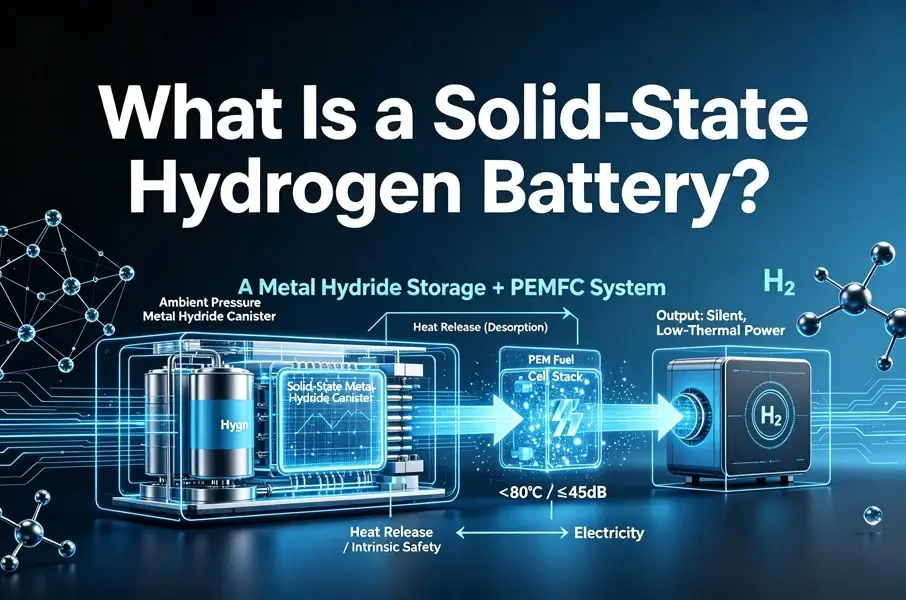
What Is a Solid-State Hydrogen Battery?
A solid-state hydrogen battery is generally better understood as a hydrogen energy system rather than a conventional electrochemical battery.
In this type of system, hydrogen is stored in a solid-state material, typically a metal hydride, and released under controlled operating conditions before being supplied to a hydrogen fuel cell to generate electrical power.
The basic energy pathway is:
Solid-state hydrogen storage → Hydrogen release → Fuel cell → Electricity
A typical system combines three major elements:
- Solid-state hydrogen storage
- Hydrogen fuel cell stack
- Power management and control system
The key difference is how energy is stored. A lithium-ion battery stores electrical energy directly through electrochemical reactions inside its cells. A solid-state hydrogen system instead stores hydrogen as an energy carrier and converts that hydrogen into electricity through a fuel cell when power is required.
In a metal hydride system, hydrogen is stored within the solid material rather than primarily as compressed gas in a conventional high-pressure cylinder. When hydrogen is needed, the storage system releases it under controlled conditions and supplies it to the fuel cell stack.
Depending on the metal hydride material and system architecture, hydrogen release can be influenced by factors such as temperature, pressure, reaction kinetics, and thermal management. The exact hydrogen release and delivery mechanism therefore depends on the specific system design.
This architecture is fundamentally different from a conventional lithium-ion battery: the metal hydride stores hydrogen as an energy carrier, while the fuel cell converts that hydrogen into electricity.
Solid-State Hydrogen Storage vs. True Solid-State Batteries
The terminology can be confusing because both technologies use the phrase solid-state.
However, they refer to different energy-storage and power-generation architectures.
True Solid-State Battery
A true solid-state battery replaces the liquid or gel electrolyte used in conventional batteries with a solid electrolyte.
The objective is to improve characteristics such as:
- Energy density
- Safety
- Thermal stability
- Cycle life
- Charging performance
The battery itself remains the primary energy storage and power-generation device.
Solid-State Hydrogen Energy System
A solid-state hydrogen system uses a solid material to store hydrogen, rather than storing electrical energy directly.
A typical system combines:
- Metal hydride hydrogen storage
- Hydrogen delivery and thermal management
- PEM fuel cell technology
- Power electronics
The fuel cell converts the stored hydrogen into electricity.
Therefore, solid-state hydrogen storage should not be confused with a true solid-state electrochemical battery.
In other words, “solid-state” describes the hydrogen storage method in one system and the electrolyte architecture in the other.
This distinction is particularly important when evaluating technologies for UAVs, portable power, remote infrastructure, and long-duration energy applications.
How Does Solid-State Hydrogen Storage Work?
Metal hydrides are materials capable of absorbing and releasing hydrogen through reversible chemical reactions.
During hydrogen charging, hydrogen molecules are introduced into the storage material under controlled conditions. The material absorbs the hydrogen and stores it in a relatively compact solid form.
When power is required, the stored hydrogen is released through a controlled desorption process.
A simplified process looks like this:
Hydrogen charging → Metal hydride storage → Controlled hydrogen release → Fuel cell → Electrical power
The amount and rate of hydrogen released depend on factors such as:
- Storage material composition
- Temperature
- Hydrogen pressure
- Thermal management
- System design
This means that thermal management is an important part of a metal hydride fuel cell system.
Unlike a conventional compressed hydrogen cylinder, the storage medium itself plays an active role in controlling hydrogen release.
How Does a Metal Hydride Fuel Cell Generate Electricity?
Once hydrogen is released from the solid-state storage material, it is supplied to a PEM fuel cell.
Inside the fuel cell, hydrogen is separated into protons and electrons.
The electrons travel through an external electrical circuit, producing usable electrical power, while the protons move through the membrane and react with oxygen.
The overall reaction is:
Hydrogen + Oxygen → Electricity + Water + Heat
The process produces electricity without combustion.
This gives hydrogen fuel cells several characteristics that are valuable for applications where low noise, low local emissions, and extended operating time are important.
In a solid-state hydrogen system, the complete energy chain therefore combines:
Solid-state hydrogen storage + PEM fuel cell + power electronics
Why Use Solid-State Hydrogen Storage?
Compared with conventional compressed hydrogen storage, solid-state hydrogen storage can provide several engineering advantages depending on the application.
1. Hydrogen Storage at Lower Pressure
Metal hydride systems store hydrogen within a solid material rather than relying primarily on conventional high-pressure compressed-gas storage.
This can reduce dependence on high-pressure cylinders and may allow different approaches to hydrogen containment, packaging, and system integration.
However, metal hydride systems are not necessarily pressure-free. Actual operating pressure depends on the storage material, temperature, hydrogen equilibrium characteristics, and system design. Specifications should therefore always be evaluated at the product level.
2. Compact System Architecture
Hydrogen is stored within the metal hydride material, allowing engineers to design compact hydrogen energy systems for applications where volume and packaging are important.
This is particularly relevant for:
- UAVs
- Portable power systems
- Robotics
- Remote sensors
- Man-portable equipment
3. Long Runtime Potential
Unlike a conventional battery, a fuel cell system does not necessarily need to store all usable energy inside the electrochemical cell itself.
Once the stored hydrogen is depleted, the system can be refueled by replacing or replenishing the hydrogen source.
For applications requiring extended operation, this can provide a different energy-storage architecture from simply increasing battery capacity.
4. Low Acoustic Signature
PEM fuel cells generate electricity electrochemically rather than through combustion.
When combined with an appropriately designed balance-of-plant system, this can enable very low acoustic signatures compared with combustion-based generators.
This characteristic is particularly valuable in applications where noise is a critical design consideration.
Solid-State Hydrogen Battery vs. Lithium-Ion Battery
The most useful comparison is not simply which technology has the highest theoretical energy density.
The better question is:
Which energy architecture provides the required combination of runtime, mass, logistics, refueling, power output, and operating conditions?
| Factor | Lithium-Ion Battery | Solid-State Hydrogen + Fuel Cell |
|---|---|---|
| Energy storage | Electrochemical | Hydrogen in solid-state material |
| Power generation | Battery discharge | PEM fuel cell |
| Refueling | Electrical charging | Hydrogen replenishment |
| Long-duration operation | Requires larger battery capacity | Can be extended through additional hydrogen |
| Mission duration | Often limited by battery capacity | Well suited to extended missions |
| Refueling / recharge downtime | Requires charging time | Hydrogen source can be replaced or replenished |
| Acoustic output | Very low | Very low with suitable system design |
| Local emissions | Zero during operation | Water and heat as electrochemical products |
| Logistics | Battery transport and charging | Hydrogen-storage logistics |
| Low-temperature performance | Requires battery thermal management | Requires hydrogen-release and fuel-cell thermal management |
| System-level energy density | Depends on battery chemistry and system design | Depends on storage material and complete system design |
| Best suited to | Short-to-medium duration loads | Applications requiring extended runtime and refueling |
The actual performance of either system depends heavily on system-level design.
For example, a battery may be the better choice for short-duration, high-power applications where electrical charging is readily available. A hydrogen fuel cell system may become more attractive when long runtime, refueling time, energy-storage mass, and off-grid operation become dominant requirements.
The appropriate choice ultimately depends on the complete mission profile rather than a single energy-density or power metric.
Solid-State Hydrogen Storage for UAVs
UAVs are one of the applications where the difference between batteries and hydrogen fuel cells becomes particularly important.
A conventional battery-powered UAV must carry sufficient battery capacity for the entire mission.
As flight duration increases, additional battery mass may reduce the useful payload or create additional energy demand.
A hydrogen fuel cell system takes a different approach.
Instead of storing all energy directly as electrical energy, the system stores hydrogen and continuously converts it into electricity during operation.
This architecture can be useful for missions requiring:
- Extended flight endurance
- Low acoustic output
- Rapid refueling
- Reduced dependence on long charging cycles
- Portable energy logistics
- Operation in remote environments
For UAV applications, however, total system mass remains critical.
The correct comparison should therefore consider the complete system, including:
Hydrogen storage + fuel cell stack + thermal management + controls + balance of plant + fuel
rather than comparing the fuel cell stack or storage material alone.
Solid-State Hydrogen Fuel Cells for Portable Power
Portable power systems face a different set of constraints.
A man-portable power source may need to operate for many hours while remaining:
- Lightweight
- Compact
- Quiet
- Reliable
- Easy to transport
- Suitable for harsh environments
A solid-state metal hydride fuel cell can address these requirements by combining hydrogen storage and fuel-cell power generation into a compact system.
For example, SOLIDHYDRO’s HYDRA-M series combines solid-state metal hydride hydrogen storage with a PEM fuel cell stack for portable and UAV-class power applications.
The system architecture is designed around the principle of storing hydrogen in a solid-state material and supplying it to the fuel cell when electrical power is required.
This approach is particularly relevant where conventional high-pressure hydrogen cylinders, frequent battery charging, or combustion generators create logistical or operational limitations.
Solid-State Hydrogen Storage for Extreme Environments
Energy systems used in extreme environments must handle more than nominal power output.
Engineers may need to consider:
- Temperature
- Vibration
- Humidity
- Dust
- Transport requirements
- Maintenance
- Refueling logistics
- Acoustic signature
- Mission duration
For these applications, the value of solid-state hydrogen storage is not simply its ability to store hydrogen.
The overall system architecture can provide a combination of hydrogen storage, controlled release, and fuel-cell power generation in a compact package.
For example, SOLIDHYDRO’s HYDRA-M platform is designed for operating conditions that can extend from approximately -40°C to +55°C, depending on configuration.
Actual operating limits, power output, and system performance should always be evaluated against the specific product specification and mission profile.
What Are the Advantages of a Metal Hydride Fuel Cell?
A metal hydride fuel cell combines two technologies:
Metal hydride hydrogen storage + PEM fuel cell power generation
This architecture can offer several potential advantages.
High Energy Storage Potential
Hydrogen contains a high amount of energy by mass.
When combined with a fuel cell, hydrogen can provide a high specific-energy pathway for applications where runtime and system mass are important.
Refueling Instead of Conventional Battery Charging
A fuel cell system can be refueled by replenishing its hydrogen supply.
This can be advantageous for applications where minimizing downtime is important.
Low Noise
PEM fuel cells operate electrochemically rather than through internal combustion.
With suitable system engineering, they can operate at very low acoustic levels.
Zero Combustion Emissions
A PEM hydrogen fuel cell does not burn hydrogen.
Its electrochemical reaction produces electricity, water, and heat.
This makes hydrogen fuel cells attractive for applications where local combustion emissions are undesirable.
Solid-State Hydrogen Storage and Fuel Cell Integration
The main value of a metal hydride fuel cell is not simply hydrogen storage or fuel-cell generation alone, but the integration of solid-state hydrogen storage, controlled hydrogen release, fuel-cell conversion, and power management into a complete power system.
What Are the Limitations?
Solid-state hydrogen systems are not a universal replacement for batteries.
There are also engineering challenges that must be considered.
Thermal Management
Metal hydride hydrogen release is temperature-dependent.
The system therefore needs an effective thermal management architecture to provide hydrogen at the required rate.
Hydrogen Supply Infrastructure
Hydrogen must be produced, supplied, or replenished.
The practical benefits of the system therefore depend on the available hydrogen logistics.
System Complexity
A complete fuel cell power system includes more components than a simple battery pack.
Depending on the application, the system may include:
- Hydrogen storage
- Fuel cell stack
- Valves
- Sensors
- Thermal management
- Air supply
- Controllers
- Power electronics
System-level optimization is therefore essential.
Initial Cost
Fuel cell systems and hydrogen storage materials can have higher initial costs than conventional battery systems.
The correct economic comparison should therefore consider total cost of ownership, including fuel, maintenance, charging infrastructure, replacement cycles, and mission downtime.
Is a Solid-State Hydrogen Battery Better Than a Lithium Battery?
There is no universal answer.
The choice depends on the mission profile.
Choose Lithium-Ion Batteries When:
- The mission is relatively short
- Electrical charging is readily available
- Low upfront cost is important
- High peak power is required
- The system can tolerate battery mass
Consider Solid-State Hydrogen Fuel Cells When:
- Long runtime is important
- Rapid refueling is valuable
- Battery mass becomes a limiting factor
- Low acoustic output is required
- Operation occurs away from the electrical grid
- Hydrogen logistics are available
- The application requires extended missions
In many cases, the future will not be about replacing batteries entirely.
Instead, battery and hydrogen fuel cell systems may be selected according to different mission requirements.
Solid-State Hydrogen Battery Applications
The combination of solid-state hydrogen storage and fuel-cell power can be considered for a range of applications.
UAVs
Extended-endurance UAVs can benefit from an energy architecture that separates hydrogen storage from electrical power generation.
Man-Portable Power
Portable fuel cell systems can provide quiet electrical power for field equipment without relying entirely on conventional battery packs.
Remote and Off-Grid Power
Hydrogen fuel cells can provide electricity in locations where grid power is unavailable or unreliable.
Robotics
Long-duration autonomous robots can use hydrogen fuel cells when extended operating time is more important than rapid high-power bursts.
Remote Monitoring
Fuel cells can provide continuous power for sensors and communication equipment in locations where frequent battery replacement is impractical.
Tactical and Defense Applications
Low acoustic output, portable energy storage, extended runtime, and reduced dependence on conventional generators can make hydrogen fuel cell systems relevant to tactical power applications.
The Future of Solid-State Hydrogen Energy Systems
The development of solid-state hydrogen storage is part of a broader shift toward alternative energy-storage architectures.
The key advantage is not simply that hydrogen can be stored in a solid material.
The more important question is how hydrogen storage, fuel-cell conversion, thermal management, and power electronics can be integrated into a complete energy system.
Future improvements may focus on:
- Higher hydrogen storage capacity
- Faster hydrogen release
- Improved thermal management
- Smaller fuel-cell stacks
- Higher system efficiency
- Lower system weight
- Better durability
- Simplified hydrogen logistics
As these technologies mature, solid-state hydrogen systems could become increasingly relevant for applications where conventional batteries or combustion generators cannot provide the required combination of runtime, weight, noise, and operational flexibility.
Frequently Asked Questions
Is a solid-state hydrogen battery the same as a solid-state battery?
No. A solid-state hydrogen battery and a true solid-state battery are different technologies.
A true solid-state battery uses a solid electrolyte to store and release electrical energy electrochemically. A solid-state hydrogen system typically stores hydrogen in a solid material such as a metal hydride and uses a fuel cell to convert that hydrogen into electricity.
The key difference is therefore what is stored in the solid-state material: electrical energy in a true solid-state battery, or hydrogen as an energy carrier in a solid-state hydrogen system.
What is solid-state hydrogen storage?
Solid-state hydrogen storage is a method of storing hydrogen within solid materials, such as metal hydrides, rather than relying solely on compressed hydrogen gas.
Hydrogen can later be released under controlled thermal and pressure conditions and supplied to a fuel cell.
What is a metal hydride fuel cell?
A metal hydride fuel cell system combines metal hydride hydrogen storage with a fuel cell, typically a PEM fuel cell.
The metal hydride stores and releases hydrogen, while the fuel cell converts that hydrogen into electrical power.
Is hydrogen better than lithium-ion batteries?
Not necessarily.
Lithium-ion batteries remain highly effective for many applications.
Hydrogen fuel cells become particularly interesting when long runtime, refueling speed, energy storage mass, and off-grid operation are important factors.
Are solid-state hydrogen systems safe?
Safety depends on the complete system design, hydrogen storage material, operating conditions, controls, and applicable standards.
Solid-state hydrogen storage can avoid some of the challenges associated with high-pressure hydrogen cylinders, but it does not eliminate the need for proper hydrogen safety engineering.
How long can a solid-state hydrogen fuel cell run?
Runtime depends on the stored hydrogen quantity, fuel-cell power output, system efficiency, and load profile.
A properly sized system can be designed for significantly longer operating periods than a similarly sized battery system in certain applications.
Can solid-state hydrogen fuel cells replace batteries in UAVs?
In some UAV applications, yes—but not universally.
Fuel cells can be attractive for long-endurance missions, while batteries can remain preferable for short flights, high peak-power requirements, or applications with convenient charging infrastructure.
Hybrid battery-fuel-cell architectures can also combine the advantages of both technologies.
Solid-State Hydrogen: A Different Approach to Energy Storage
The term solid-state hydrogen battery can describe an emerging class of energy systems, but it is important to understand the underlying technology.
A true solid-state battery stores electrical energy using a solid electrolyte.
A solid-state hydrogen system instead uses solid-state hydrogen storage, such as metal hydrides, together with a fuel cell to generate electricity.
For applications where long runtime, low noise, portable energy, rapid refueling, and operation in remote environments are important, this architecture offers an alternative to conventional battery and combustion-based power systems.
SOLIDHYDRO develops solid-state hydrogen and fuel-cell solutions for applications ranging from UAV and man-portable power to off-grid and heavy-duty energy systems.
The HYDRA-M platform combines solid-state metal hydride hydrogen storage with PEM fuel cell technology to provide compact hydrogen power for demanding operating environments.
As hydrogen storage and fuel-cell technologies continue to evolve, solid-state hydrogen systems are positioned to become an increasingly important option for next-generation portable and distributed power.
Explore Solid-State Hydrogen Power for Your Application
Looking for longer runtime, low-noise power, rapid refueling, or solid-state hydrogen storage?
SOLIDHYDRO’s engineering team can help evaluate the right hydrogen power architecture for your application — from HYDRA-M solid-state metal hydride fuel cells to larger hydrogen fuel cell systems.
👉 Explore HYDRA‑M: Solid‑State Hydrogen Fuel Cell for Tactical Power
👉 View Tactical Power Solutions
👉View Hydrogen Fuel Cell Solutions →