Every power module has its limits. What separates an industrial‑grade system from an infrastructure‑class solution is not the size of a single module — it is the ability to scale like building blocks, adding power as needed without redesigning the entire system.
The HYDRA‑G series — 120kW and 205kW PEMFC modules — is engineered for exactly this purpose. They share a common modular parallel architecture: from powering a large Unmanned Underwater Vehicle (UUV) to serving as MW‑class backup for a data centre, parallel architecture transforms a standardised module into an infinitely scalable power station.
And the journey often begins underwater.
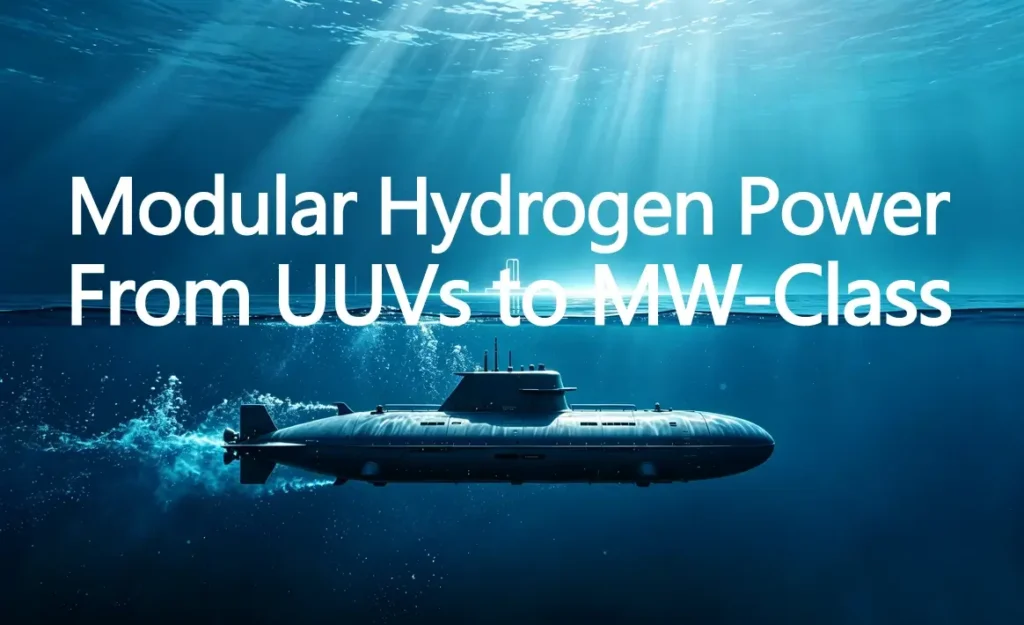
UUVs: The First Frontier for Modular Parallel Power
Unmanned Underwater Vehicles (UUVs) and Autonomous Underwater Vehicles (AUVs) impose uniquely demanding requirements on propulsion systems: long endurance, high reliability, silent operation, and Air‑Independent Propulsion (AIP). Conventional lithium batteries lack the energy density to sustain weeks or even months of submerged missions. Diesel engines require oxygen — they cannot operate underwater.
Hydrogen fuel cells provide the answer. High energy density, low noise, and air‑independent operation — these characteristics make PEMFC an ideal power source for large UUVs.
But the power requirements of underwater vehicles span a vast range:
- Small AUVs: 500W–3kW
- Medium‑to‑large UUVs: 5kW–30kW
- Large UUVs and AIP submarines: 100–200kW
A single 205kW PEMFC module covers the full power requirement of a large UUV. But for larger underwater platforms — or for underwater mothership charging stations that need to recharge multiple UUVs simultaneously — a single module is no longer sufficient.
This is where modular parallel architecture proves its value.
In July 2026, a hydrogen‑powered underwater robot successfully completed sea trials, achieving an order‑of‑magnitude increase in endurance compared to conventional lithium‑powered systems through modular fuel cell design. Another hydrogen‑powered AUV achieved a 5,000‑km range, far surpassing battery‑powered counterparts. An industry‑leading hydrogen‑powered AUV completed a fully submerged mission exceeding 2,000 km over 385 hours of continuous operation.
Behind these breakthroughs lies the same logic: replacing lithium batteries — which have reached their physical energy density limits — with modular fuel cell systems.
HYDRA‑G’s modular parallel architecture is the industrial‑scale extension of this logic — from kW‑class small AUVs to MW‑class underwater platforms, using standardised modules to cover non‑standardised power requirements.
HYDRA‑G’s Modular DNA: One Architecture, Two Power Ratings
HYDRA‑G 120kW and 205kW share the same modular design philosophy — the difference is simply the power rating of each module.
| Parameter | HYDRA‑G 120kW | HYDRA‑G 205kW |
|---|---|---|
| Rated Power | 120kW (scalable to 200kW+) | 205kW (parallel‑ready, scalable to MW) |
| Gravimetric Power Density | 510W/kg | 702W/kg |
| Volumetric Power Density | — | 4.71kW/L |
| Peak Efficiency | 61.25% | — |
| Dynamic Response | 5.1kW/s | — |
| Output Voltage | 450–750V DC | 330–750V DC |
| Operating Temperature | -30°C to +55°C | -40°C to +60°C |
| Ingress Protection | IP67 / MIL‑STD‑810G | IP67 |
| Cooling Method | Liquid‑cooled, closed‑cathode | Liquid‑cooled |
| Hydrogen Input | 70MPa CGH₂ | 70MPa CGH₂ |
| Certification | CAERI Type Approval | CAERI Type Approval |
The 120kW module offers finer granularity. When load requirements are not multiples of 205kW, 120kW modules enable more precise capacity matching with less over‑capacity. Additionally, the 120kW module delivers 5.1kW/s dynamic response and 61.25% peak efficiency — advantages in applications requiring frequent load adjustments.
The 205kW module offers higher density. 702W/kg gravimetric power density and 4.71kW/L volumetric power density mean more power in less space — whether in a data centre server room, a ship’s engine compartment, or a large UUV’s equipment bay, space is always a premium.
Metallic bipolar plate technology underpins both modules. Compared to traditional graphite bipolar plates, metallic plates are thinner, offer better electrical and thermal conductivity, and enable significantly higher volumetric power density — the compactness that allows HYDRA‑G 205kW to achieve industry‑leading power density while maintaining high output.
Most importantly: neither module was designed as a “standalone” unit. Their electrical interfaces, control protocols, cooling circuits, and hydrogen supply systems are all optimised for parallel expansion.
Parallel Architecture: The Engineering Logic from 1 to N
Parallel operation is not simply connecting multiple generators with cables. True modular parallel architecture requires standardisation across four critical domains.
1. Electrical Parallel: Power Aggregation
Multiple HYDRA‑G modules connect through a common DC bus, with output power scaling linearly. Five 205kW modules → 1.025MW. Ten 120kW modules → 1.2MW.
The key is current‑sharing control — ensuring each module carries the same proportion of the load, preventing one module from overloading while another sits idle. Each HYDRA‑G module is equipped with an intelligent power management unit that communicates via high‑speed CAN bus, dynamically adjusting each module’s output to maintain load balance across the entire parallel system.
2. Fuel Supply: Hydrogen Distribution
MW‑class parallel systems require corresponding hydrogen supply capacity. 70MPa CGH₂ is distributed to each module through a central distribution manifold, with each module’s inlet pressure controlled by an independent regulator.
For stationary power plants, on‑site hydrogen generation + buffer storage is an option — electrolysers produce hydrogen during off‑peak electricity pricing periods, with buffer tanks ensuring a stable hydrogen supply to PEMFC modules at all times.
3. Thermal Management: Waste Heat Integration
Each HYDRA‑G module generates significant waste heat at full load. In a parallel system, this heat can be centrally recovered — used for building heating, process pre‑heating, or absorption cooling.
The parallel thermal management system follows the same logic as the electrical system: centralised hot/cold source distribution + module‑level independent temperature control. The coolant inlet temperature for each module is centrally managed to ensure all modules operate within the optimal temperature range (60–80°C).
4. Control Architecture: From Single Unit to Cluster
Control for a single module is relatively simple. But when ten, twenty, or more modules operate simultaneously, control architecture complexity rises exponentially.
HYDRA‑G’s parallel architecture uses a three‑layer control hierarchy:
- Module layer: Each module’s local controller monitors operational status and handles basic control
- Cluster layer: The cluster controller manages load distribution, start/stop sequencing, and fault isolation
- System layer: The supervisory system interfaces with the user’s Energy Management System (EMS), coordinating with the grid, energy storage, and loads
“n+1” redundancy is another key feature of the parallel architecture. If a cluster needs 10 modules to meet peak load, deploy 11 — any single module can fail while the remaining 10 continue to deliver full power. This design minimises single‑point‑of‑failure risk.
120kW vs 205kW: Selection Logic in Parallel Scenarios
Both modules share the same core parallel architecture — the difference is not “whether they can be paralleled” but “what value they deliver when paralleled.”
| Dimension | HYDRA‑G 120kW Parallel | HYDRA‑G 205kW Parallel |
|---|---|---|
| Single module power | 120kW | 205kW |
| Modules required for 1MW | 9 units | 5 units |
| Modules required for 2MW | 17 units | 10 units |
| Capacity matching precision | Higher (finer granularity) | Lower |
| System complexity | Higher (more modules) | Lower (fewer modules) |
| Footprint | Larger | Smaller |
| Dynamic response | 5.1kW/s | — |
| Peak efficiency | 61.25% | — |
120kW advantages:
- Finer granularity — when load requirement is 600kW, 5 × 120kW (600kW) matches more precisely than 3 × 205kW (615kW)
- Faster dynamic response — 5.1kW/s load‑following capability suits frequently fluctuating loads
- Higher efficiency — 61.25% peak efficiency means lower fuel cost over long‑term operation
205kW advantages:
- Higher density — 702W/kg and 4.71kW/L offer clear advantages in space‑constrained applications
- Simpler system — fewer modules per MW, fewer control nodes, lower installation and maintenance workload
- Broader extreme‑environment tolerance — -40°C to +60°C operating range covers everything from the Arctic to the desert
Application Scenarios: Where Parallel Architecture Excels
Scenario 1: Large UUVs and AIP Systems
Requirement: A large UUV needs 100–200kW of sustained propulsion power plus weeks of submerged endurance.
HYDRA‑G solution: A single 120kW or 205kW module can meet the full power requirement of a large UUV. For larger underwater platforms — or underwater mothership charging stations that need to recharge multiple UUVs simultaneously — multiple modules in parallel deliver MW‑class charging capacity.
Key advantages:
- Air‑Independent Propulsion (AIP) — no oxygen required, suitable for extended submerged operations
- Low noise — PEMFC runs silently, does not interfere with sonar systems
- High energy density — significantly longer endurance than lithium batteries at the same weight
Scenario 2: Data Centre Backup Power
Requirement: A mid‑sized data centre with 2MW IT load requires backup power that takes over within 15 seconds of grid failure.
Conventional solution: Diesel generators + UPS batteries. Diesel start‑up takes time; UPS batteries are costly and maintenance‑intensive.
HYDRA‑G parallel solution: 10 × 205kW modules (2.05MW) or 17 × 120kW modules (2.04MW), standing by in hot‑standby mode. When grid power fails, PEMFC responds in milliseconds — no UPS battery transition required. Hydrogen reserves support 48+ hours of continuous operation.
Scenario 3: Mining Truck Charging Station
Requirement: An open‑pit mine operates 20 electric haul trucks, each requiring 1MW charging power, with charging to be completed within shift change windows.
HYDRA‑G parallel solution: 5 × 205kW (1.025MW) or 9 × 120kW (1.08MW), combined with battery storage as a buffer. During truck charging, PEMFC delivers continuous base power while batteries handle peak loads. Zero diesel emissions, zero noise pollution, maintenance cost a fraction of diesel generators.
Scenario 4: Island Microgrid
Requirement: A remote island community with 3MW peak load, no grid connection, fully dependent on local generation.
HYDRA‑G parallel solution: 15 × 205kW (3.075MW) or 25 × 120kW (3.0MW), combined with PV and storage in a hybrid multi‑energy microgrid. PEMFC serves as baseload power, PV supplements during daylight, storage smooths peaks and valleys. Hydrogen can be supplied via ship‑borne Liquid Organic Hydrogen Carriers (LOHC) or on‑site seawater electrolysis — completely eliminating diesel import dependency.
Scenario 5: Large Marine Vessel Propulsion
Requirement: A coastal ferry or cargo vessel with 4MW propulsion power must meet increasingly stringent IMO emissions regulations.
HYDRA‑G parallel solution: 20 × 205kW (4.1MW) or 34 × 120kW (4.08MW), directly driving electric motors and propellers. Zero carbon emissions, zero SOx, zero NOx — fully compliant with IMO Tier III and Euro VII standards.
Selection Guide: 120kW or 205kW?
| If your scenario is… | Recommendation | Rationale |
|---|---|---|
| Large UUV / AIP system | HYDRA‑G 120kW or 205kW | Single module covers full power; multiple modules support underwater charging stations |
| Data centre backup | HYDRA‑G 205kW | Space‑constrained, power density priority; fewer modules, simpler system |
| Mining truck charging | Depends on space and scalability needs | 120kW offers finer granularity for precise matching; 205kW offers higher density, smaller footprint |
| Island microgrid | HYDRA‑G 120kW | Gradual load growth, phased investment; finer granularity for flexible scaling |
| Marine vessel propulsion | HYDRA‑G 205kW | Engine room space limited; power density priority |
| Multi‑site distributed deployment | HYDRA‑G 120kW | 2–4 units per site, power tailored to each location; moderate granularity |
Conclusion: One Architecture, Infinite Possibilities
From large UUVs to data centres, from island microgrids to ocean‑going vessels — one HYDRA‑G module is the starting point; MW‑class power is the destination; parallel architecture is the bridge.
HYDRA‑G 120kW and 205kW are not competitors — they are complementary choices for different power‑density requirements:
- 120kW: finer granularity, faster dynamic response, higher efficiency — ideal for applications requiring precise capacity matching and frequent load adjustment
- 205kW: higher density, simpler system, broader extreme‑environment tolerance — ideal for space‑constrained applications demanding maximum power density
Both share the same parallel architecture — standardised interfaces, modular scalability, redundant design, intelligent control.
Whether your power requirement is 120kW or 20.5MW, the architecture is the same.
Continue reading:
- Explore HYDRA‑G 120kW Specifications
- Explore HYDRA‑G 205kW Metallic‑Plate PEMFC
- The Third Path: Hydrogen PEMFC vs BEV for Heavy‑Duty Trucks
- Beyond Diesel: HYDRA‑G 120kW Off‑Grid Industrial Power
- View All Blog Posts