The challenge of off‑grid industrial power is deceptively simple: you need reliable electricity, but diesel generators are consuming your margins.
A remote mining site, a border radar station, an off‑grid 5G base station — these sites share one thing in common: no grid access, requiring on‑site power generation. Diesel generators appear to be the only option. But when you factor in fuel transport, maintenance costs, downtime losses, and emissions compliance, the “low cost” of diesel is an illusion.
HYDRA‑G 120kW offers an industrial‑grade alternative: 120kW continuous power, 8–20 minute refueling, -30°C cold start, IP67 protection, and zero emissions.
This is not experimental technology. This is CAERI type‑approved, deployable industrial power.
The Real Cost of Diesel in Remote Sites
Diesel fuel itself is not expensive. What is expensive is getting it to where it is needed.
At remote mining sites, agricultural operations, or coastal facilities, diesel logistics premiums range from 30% to 80% of the delivered price. In extreme cases, diesel prices at remote islands have exceeded $4.25 per litre. Arctic and mountainous operations even rely on seasonal ice roads or helicopter transport, multiplying costs further.
This is not a one‑time cost. This is a continuous drain on every litre of fuel consumed.
Beyond the fuel itself, diesel generators impose additional burdens:
- Maintenance costs: Oil, filter, and belt changes every 250–500 hours. At remote sites, dispatching a technician often costs more than the maintenance itself.
- Downtime losses: Fuel supply disruptions mean communication blackouts, data loss, and mission failure.
- Compliance costs: Increasingly stringent emissions regulations are pushing diesel generators out of the market.
The “low cost” of diesel has never been on the fuel station price tag — it is in the total cost of ownership.
Why PEMFC for High‑Power Off‑Grid?
For off‑grid applications requiring 50kW+ continuous power, PEMFC offers advantages that diesel generators cannot match.
1. Continuous Reliability, Free from Fuel Supply Constraints
A PEMFC is a static energy conversion device — no pistons, no crankshafts, no moving parts in the stack to wear out. As long as hydrogen is supplied, the PEMFC delivers rated power continuously, with runtime limited only by the hydrogen storage capacity.
For off‑grid sites, this means:
- No scheduled maintenance shutdowns — no oil changes, no filter replacements
- Unaffected by extreme cold — PEMFC starts reliably at -30°C, while diesel gels and fails in freezing conditions
- Quiet operation — none of the roar and vibration of internal combustion engines
2. Far Higher Efficiency Than Internal Combustion Engines
PEMFC achieves electrical efficiency of up to 60% — far surpassing the 33–35% efficiency of conventional diesel gensets. This means for the same energy input, PEMFC delivers nearly twice the electricity — lower fuel costs, fewer emissions.
3. Rapid Refueling, Not Long Waiting
Unlike battery‑based energy storage, PEMFC refuels by hydrogen dispensing, not recharging. HYDRA‑G 120kW refuels in just 8–20 minutes — comparable to diesel refuelling and far faster than the hours required for battery charging.
For 24/7 off‑grid operations, this means no downtime waiting.
HYDRA‑G 120kW: Industrial‑Grade Specifications
HYDRA‑G 120kW is a PEMFC system engineered for industrial‑grade off‑grid deployment:
| Parameter | Specification |
|---|---|
| Rated Power | 120kW (Scalable to 200kW+) |
| Peak Efficiency | 61.25% |
| Power Density | 510W/kg |
| Dynamic Response | 5.1kW/s |
| Operating Voltage | 450–750V DC |
| Operating Temperature | -30°C to +55°C |
| Hydrogen Pressure | 70MPa CGH₂ Ready |
| Cooling Method | Liquid‑Cooled |
| Ingress Protection | IP67 |
| Vibration Standard | MIL‑STD‑810G |
| Certification | CAERI Type Approval |
What do these numbers mean in practice?
510W/kg power density means HYDRA‑G 120kW is 27.5% lighter than comparable systems at the same power output (versus the industry ~400W/kg benchmark) — and for equipment that must be transported to remote sites, weight is cost.
61.25% peak efficiency means lower hydrogen consumption, lower fuel costs, and fewer emissions.
IP67 ingress protection means the system operates in dusty environments and temporary immersion — no additional protective enclosure required.
MIL‑STD‑810G vibration compliance means the system withstands transit vibrations and on‑site mechanical shock — no special vibration isolation needed.
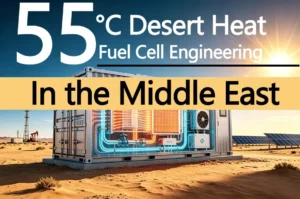
-30°C to +55°C full‑climate operation means one system covers all environments — from the Arctic to the desert.
Application Scenarios: Where HYDRA‑G 120kW Excels
Off‑Grid 5G Base Stations and Communication Hubs
Requirement: 24/7 continuous power, 8,760 hours per year, zero downtime tolerance Challenge: Long diesel delivery lead times, high maintenance costs, outage risk
HYDRA‑G 120kW advantages:
- 120kW capacity supports large communication base stations and data processing centres
- 8–20 minute hydrogen refueling — no downtime waiting
- No moving parts to wear — maintenance costs are minimal
- IP67 protection — outdoor deployment without additional shelter
Remote Mining Sites and Exploration Camps
Requirement: High‑power continuous supply, extreme environment tolerance Challenge: Diesel transport costs are extreme (Arctic and mountainous sites can see $1.50–3.00+/litre), emissions regulations are tightening
HYDRA‑G 120kW advantages:
- 120kW capacity supports equipment charging, camp power, ore processing
- Zero emissions — meets increasingly stringent mining emissions regulations
- -30°C cold start — ideal for Arctic mining operations
- MIL‑STD‑810G vibration compliance — unaffected by heavy equipment vibration
Border Outposts and Radar Stations
Requirement: High reliability, low detectability, extreme environment tolerance Challenge: Diesel generator noise and thermal radiation reveal position
HYDRA‑G 120kW advantages:
- Quiet operation — no internal combustion engine roar
- Low thermal radiation — infrared signature far lower than diesel generators
- IP67 protection — outdoor deployment without additional shelter
- CAERI type approval — meets military and industrial deployment standards
Disaster Response and Temporary Deployment
Requirement: Rapid deployment, instant power, high reliability Challenge: Diesel supply chains can be severed during disasters
HYDRA‑G 120kW advantages:
- Modular design — rapid deployment
- Hydrogen can be supplied via tube trailers or on‑site generation
- Zero diesel dependency — unaffected by fuel supply chain disruptions
- Parallel‑capable to MW‑scale — meets large‑scale emergency response needs
TCO: The 5‑Year Picture
For a typical off‑grid communication site, the 5‑year TCO comparison looks like this:
| Cost Category | Diesel Generator | HYDRA‑G 120kW |
|---|---|---|
| Equipment (CapEx) | $8,000–$15,000 | Higher |
| Fuel cost (5 years) | $20,000–$30,000+ | Hydrogen price‑dependent |
| Fuel transport cost (5 years) | $6,000–$24,000+ (30–80% premium) | Significantly lower |
| Maintenance cost (5 years) | $5,000–$15,000+ | Minimal (no moving parts) |
| Downtime / interruption cost | High | Very low |
| Emissions compliance cost | Rising trend | Zero |
| 5‑Year Total TCO | $40,000–$80,000+ | Trending toward parity (around 2030) |
While HYDRA‑G 120kW has a higher upfront equipment cost, lower maintenance, significantly lower fuel transport costs, and zero emissions compliance costs rapidly narrow the difference. For sites with the highest diesel logistics premiums — Arctic, mountainous, island — the TCO advantage can already tip in favour of hydrogen. As hydrogen infrastructure scales and green hydrogen production costs continue to decline, the gap closes further across all deployment scenarios.
→ For a broader cost comparison: 5‑Year TCO: Fuel Cells vs Diesel vs Lithium
The SOLIDHYDRO Advantage
HYDRA‑G 120kW is not a laboratory prototype — it is CAERI type‑approved and ready for immediate deployment.
- CAERI Type Approval: Meets national fuel cell certification standards for road and industrial applications
- IP67 Protection: Dust‑proof and water‑immersion resistant — outdoor deployment without additional protection
- Tested to MIL‑STD‑810G :Vibration and salt‑spray tested for harsh environments
- Fully Integrated BoP: Air, hydrogen, coolant, and control systems in a unified design — reducing integration complexity
SOLIDHYDRO’s engineering team provides end‑to‑end deployment support — from site assessment and system sizing to BoP integration and on‑site commissioning.
→ View full HYDRA‑G 120kW specifications
For lower‑power off‑grid applications (<200W), SOLIDHYDRO also offers the HYDRA‑R methanol reforming solution — fuel cost at approximately ¼ of gasoline, ≤45dB silent operation, ideal for sensors, cameras, and outpost low‑power requirements.
Conclusion: The Industrial‑Grade Off‑Grid Solution
The choice of high‑power off‑grid power is fundamentally a trade‑off between reliability, cost, and environmental resilience.
Diesel generators trade “low‑cost equipment” for expensive operations and tightening compliance pressure. Lithium batteries trade “clean energy” for weight, cold‑weather failure, and long charging times.
HYDRA‑G 120kW offers a different answer:
- 120kW continuous power, scalable in parallel to MW‑scale
- 61.25% peak efficiency — far surpassing internal combustion engines
- 8–20 minute hydrogen refueling — comparable to diesel, far faster than batteries
- -30°C to +55°C full‑climate operation — from the Arctic to the desert
- IP67 protection + MIL‑STD‑810G vibration compliance — no additional protection required in harsh environments
- CAERI type approval — ready for immediate deployment
When your off‑grid mission demands industrial‑grade reliability, rapid refueling, extreme environment tolerance, and zero emissions — HYDRA‑G 120kW is the proven answer.
Continue reading: