How much does a hydrogen fuel cell cost over five years compared with diesel generators and lithium batteries?
The answer depends on more than the initial purchase price.
For off-grid, remote and long-duration power applications, the real cost of a power system includes equipment, fuel or energy, maintenance, logistics, replacement and downtime.
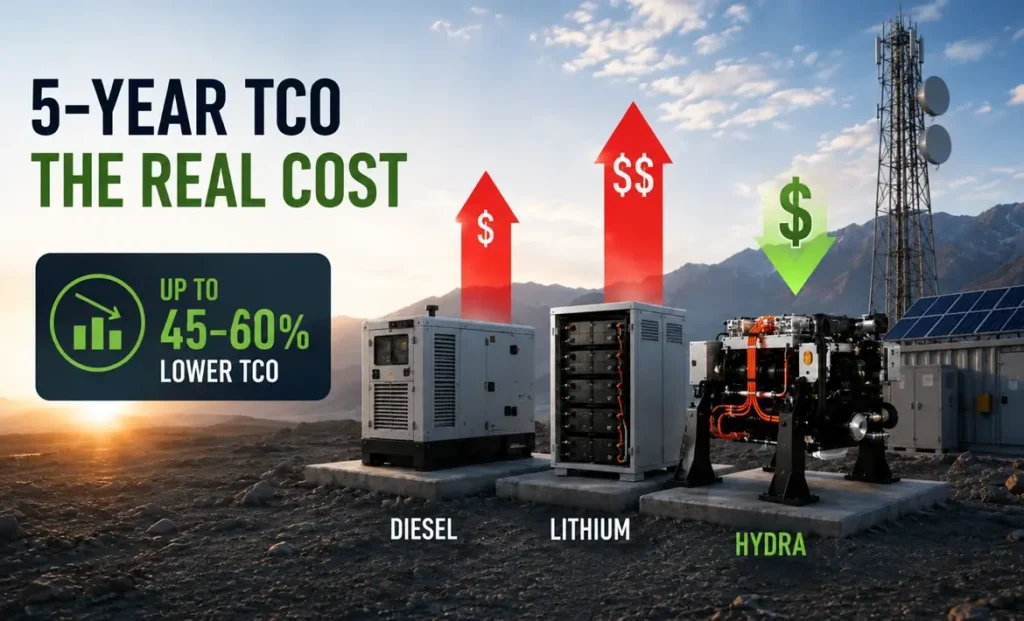
This guide compares the 5-year total cost of ownership (TCO) of hydrogen fuel cells, diesel generators and lithium-ion batteries to help engineers, system integrators and procurement teams evaluate the most cost-effective power solution for their operating profile.
The objective is not to determine which technology is universally cheapest. It is to identify which power technology delivers the lowest lifecycle cost for a specific mission.
What Is Total Cost of Ownership (TCO)?
Total Cost of Ownership is the complete cost of operating a power system over its service life.
For a five-year evaluation, TCO can include:
- Initial equipment cost
- Fuel or electricity cost
- Maintenance
- Fuel and energy logistics
- Replacement components
- Charging or refueling infrastructure
- Transport et stockage
- Downtime
- End-of-life costs
A simple TCO model can be expressed as:
5-Year TCO = Initial Cost + Energy Cost + Maintenance + Logistics + Replacement + Downtime
This approach is more useful than comparing equipment prices alone.
A lithium battery may have a relatively low initial cost but require additional battery capacity, charging infrastructure or replacement packs for long-duration operation.
A diesel generator may have competitive upfront pricing but incur recurring fuel, maintenance and logistics costs.
A hydrogen fuel cell may have a higher initial system cost while offering advantages in long-duration operation, low maintenance requirements, rapid refueling and zero point-of-use emissions.
The actual result depends on the operating profile.
Hydrogen Fuel Cell vs Diesel vs Lithium: What Drives Cost?
Hydrogen fuel cells, diesel generators and lithium batteries have fundamentally different cost structures.
| Cost Factor | Pile à combustible à hydrogène | Générateur diesel | Batterie au lithium |
|---|---|---|---|
| Initial Equipment Cost | Medium–High | Low–Medium | Low–Medium |
| Energy / Fuel Cost | Hydrogen dependent | Diesel dependent | Electricity dependent |
| Maintenance | Generally low | Generally high | Low–Medium |
| Refueling / Recharging | Minutes for many systems | Minutes | Typically longer |
| Local Emissions | Zero at point of use | Combustion emissions | Zero at point of use |
| Bruit | Faible | Élevé | Très faible |
| Fonctionnement de longue durée | Strong | Strong | Requires recharge strategy |
| Remote Logistics | En fonction de l'application | Often demanding | Charging dependent |
| Battery Replacement | N/A | N/A | En fonction de l'application |
| Best Fit | Long-duration, high-utilization applications | Conventional high-power generation | Shorter-duration or charge-access applications |
This table should be treated as a technology-selection framework, not a universal cost ranking.
The most economical solution depends on power demand, annual operating hours, energy prices, logistics and the required service life.
What Is the 5-Year Cost of a Hydrogen Fuel Cell?
The cost of a hydrogen fuel cell system should be evaluated across several categories.
Initial System Cost
The initial investment may include:
- Pile à combustible
- Balance of plant
- Stockage de l'hydrogène
- Électronique de puissance
- Controls
- Cooling system
- Installation
- Intégration
For mobile and remote applications, system weight and integration requirements can also influence the effective cost of deployment.
Hydrogen Cost
Hydrogen fuel cost depends on:
- Hydrogen production method
- Local hydrogen price
- Delivery method
- Pression de stockage
- Consumption rate
- Refueling infrastructure
- Annual operating hours
There is therefore no single hydrogen price that can be used for every TCO calculation.
A site with established hydrogen infrastructure may have a very different cost structure from a remote deployment that requires delivered hydrogen.
Coût d'entretien
Fuel cell systems do not require the same maintenance procedures as combustion engines.
For example, a hydrogen fuel cell powertrain does not require conventional engine oil changes or diesel exhaust after-treatment maintenance.
However, fuel cells are not maintenance-free.
Maintenance requirements may include:
- Air management
- Systèmes de refroidissement
- Pumps or fans
- Vannes
- Capteurs
- Controls
- Fuel-cell stack service
The correct comparison is therefore not “no maintenance vs high maintenance”, but rather how the maintenance profile affects five-year operating cost.
Hydrogen Fuel Cell vs Diesel: Which Costs Less Over 5 Years?
Diesel generators remain highly practical for many high-power applications, particularly where fuel infrastructure is already established.
They are familiar, widely available and capable of delivering high power for long periods.
However, their five-year TCO includes more than diesel fuel.
Typical cost categories include:
- Diesel fuel
- Engine oil
- Filters
- Scheduled servicing
- Wear components
- Exhaust-treatment systems
- Fuel transportation
- Storage
- Technician visits
- Generator downtime
For remote deployments, logistics can become a significant part of the operating cost.
A fuel-cell system can eliminate combustion-related maintenance categories and local exhaust emissions, although hydrogen supply and infrastructure must be included in the TCO calculation.
SOLIDHYDRO’s HYDRA-G 120kW product information similarly notes that TCO depends on hydrogen price, utilization, maintenance, infrastructure and local conditions rather than being inherently lower in every application.
The key question is not:
Which system is cheaper to buy?
La question qu'il convient plutôt de se poser est la suivante :
Which system costs less to operate for the required number of hours?
When Can Hydrogen Fuel Cells Have a TCO Advantage Over Diesel?
Hydrogen fuel cells can become more attractive when an application has several of these characteristics:
- High annual operating hours
- Continuous power demand
- Déploiement à distance
- High cost of maintenance visits
- High fuel logistics costs
- Low-noise requirements
- Zero point-of-use emissions requirements
- Rapid refueling requirements
- High cost of downtime
For occasional backup power, diesel may remain economically competitive.
For continuous remote power, however, fuel logistics and maintenance can become more important than the initial equipment price.
The break-even point must therefore be calculated using actual operating data.
Hydrogen Fuel Cell vs Lithium Battery: Total Cost of Ownership
Lithium-ion batteries are highly competitive when charging infrastructure is readily available and operating duration is relatively short.
They are particularly suitable for:
- Short-duration missions
- High-power bursts
- Indoor applications
- Urban environments
- Applications with regular access to the electrical grid
The economics become more complex when continuous operation is required.
A long-duration battery system may require:
- Larger battery capacity
- Additional battery packs
- Battery swapping
- Charging infrastructure
- Spare batteries
- Gestion thermique
- Battery replacement
For remote power applications, these additional requirements should be included in the five-year TCO.
When Can Hydrogen Fuel Cells Have a TCO Advantage Over Lithium?
Fuel cells can become attractive when the application requires:
Long runtime + rapid refueling + high utilization + limited charging access
Instead of storing all required energy inside a large battery pack, a fuel-cell system converts stored fuel into electricity continuously.
This makes the economic comparison fundamentally different.
The relevant question becomes:
How much does it cost to provide the required energy over five years?
rather than:
How much does the battery pack cost?
For example, SOLIDHYDRO’s HYDRA-M 60W and 120W systems are designed for long-duration portable and UAV applications, with published configurations offering 27+ hours and 10+ hours of operation respectively under specified conditions.
How Fuel Logistics Affect 5-Year TCO
Fuel logistics are often overlooked in power-system cost calculations.
For a remote deployment, the real energy cost can include:
- Fuel purchase
- Packaging
- Transportation
- Storage
- Handling
- Resupply personnel
- Site access
- Storage infrastructure
- Emergency resupply
The same principle applies to batteries.
Battery logistics can include:
- Transportation of battery packs
- Charging infrastructure
- Spare batteries
- Battery swapping
- Return logistics
- Replacement
Par conséquent, energy logistics should be included in any serious five-year TCO model.
This is particularly important for tactical, remote and off-grid applications where the cost of physically moving energy can exceed the nominal energy price.
Why Operating Hours Matter More Than Purchase Price
Annual operating hours are one of the most important variables in a TCO calculation.
Consider two simplified scenarios.
Low Utilization
A system operates only a few hundred hours per year.
In this case:
- Initial equipment cost matters more
- Maintenance costs remain relatively low
- Battery charging may be convenient
- Diesel may remain highly competitive
High Utilization
A system operates continuously or thousands of hours per year.
Now:
- Fuel consumption becomes significant
- Maintenance accumulates
- Battery replacement becomes more important
- Logistics become more expensive
- Downtime becomes more costly
This is why a technology that appears expensive at purchase can become competitive over its service life.
How to Calculate 5-Year TCO for Off-Grid Power
A practical TCO calculation should start with the actual load profile.
Step 1: Determine Average Load
Par exemple :
Average Load = 60W
Step 2: Determine Annual Operating Hours
For continuous operation:
Annual Operating Hours = 8,760 hours
For intermittent operation, use the actual duty cycle.
Step 3: Calculate Annual Energy Demand
Annual Energy = Average Load × Operating Hours
For a 60W continuous load:
60W × 8,760h = 525.6kWh per year
Over five years:
2,628kWh
This is an illustrative energy requirement, not a product performance claim.
Step 4: Calculate Energy Cost
Multiply the required energy by the actual energy cost for each technology.
Step 5: Add Maintenance
Include:
- Scheduled service
- Consumables
- Replacement components
- Stack service
- Battery replacement
Step 6: Add Logistics
Include:
- Alimentation en carburant
- Transportation
- Storage
- Charging infrastructure
- Site visits
Step 7: Add Downtime
For mission-critical applications:
Downtime Cost = Lost Operating Hours × Cost per Operating Hour
This can materially change the final TCO.
What Should a Real 5-Year TCO Comparison Include?
A professional TCO model should include at least six categories.
| TCO Category | What to Include |
|---|---|
| CAPEX | Power system, storage, controls, installation |
| Energy | Hydrogen, diesel, methanol or electricity |
| Maintenance | Service, consumables, components |
| Logistique | Transportation, storage, resupply |
| Replacement | Battery packs, stack or other major components |
| Downtime | Lost operating time and service interruptions |
The calculation should use actual supplier pricing and operating assumptions wherever possible.
Avoid using generic statements such as “fuel cell = low cost” or “battery = high cost” without defining the operating scenario.
TCO Example: 60W Remote Power System
A useful way to compare technologies is to start with the same electrical load.
For a continuous 60W application:
60W × 24 hours × 365 days = 525.6kWh/year
Over five years:
525.6kWh × 5 = 2,628kWh
This provides a common energy requirement for comparing different power architectures.
The final TCO should then be calculated using the actual:
- System price
- Fuel price
- Electricity price
- Efficacité
- Maintenance schedule
- Replacement interval
- Logistics cost
- Environnement d'exploitation
For this reason, SOLIDHYDRO recommends application-specific TCO modeling rather than using a single universal cost figure. The company’s HYDRA-R page, for example, explicitly offers TCO analysis against diesel or battery configurations based on specific site conditions and fuel logistics.
How SOLIDHYDRO Fuel Cell Systems Fit Different TCO Scenarios
SOLIDHYDRO offers different fuel-cell architectures for different power and fuel-logistics requirements.
HYDRA-M : pile à combustible à hydrure métallique à l'état solide
HYDRA-M combines solid-state metal hydride hydrogen storage with a PEM fuel-cell stack.
The system is designed for portable and UAV applications where long runtime, low acoustic output and simplified hydrogen storage are important.
Published HYDRA-M configurations include:
- 60W rated output
- 120W steady output
- Up to 1200Wh/kg published fuel density
- Fonctionnement à ≤45 dB
- -40°C to +55°C operating temperature
- 27+ hours for the 60W model under specified conditions
- 10+ hours for the 120W model at full load under specified conditions
This makes HYDRA-M particularly relevant to man-portable power, tactical systems, remote sensors and UAV support.
HYDRA-R : pile à combustible au méthanol de nouvelle génération
HYDRA-R uses onboard methanol reforming to generate hydrogen for a fuel-cell stack.
This architecture is designed for applications where liquid-fuel logistics are more practical than hydrogen supply.
The HYDRA-R 60W system is specified for:
- 60W rated output
- Up to 80W peak
- ≤6.0kg including fuel
- ≤ 45 dB
- de -40 °C à +50 °C
- Up to 3,500m altitude
- Long-duration refillable operation
HYDRA-R is therefore relevant to remote telecom, infrastructure monitoring, security systems and other long-duration off-grid applications.
HYDRA-G: Hydrogen PEM Fuel Cell Systems
HYDRA-G covers higher-power hydrogen PEM fuel-cell applications.
La gamme de produits actuelle comprend :
- 3,3 kW for UAVs and light mobility
- 120 kW for heavy-duty vehicles
- 205 kW for stationary, marine and MW-scale applications
The 120kW system is specified at up to 61.25% peak efficiency, while the 205kW system reaches 702W/kg power density and supports parallel configurations for larger power requirements.
For these higher-power systems, TCO should include:
- Hydrogen cost
- Vehicle or equipment utilization
- Stack service
- Maintenance
- Hydrogen infrastructure
- Durée du ravitaillement
- Fleet or site logistics
Hydrogen Fuel Cell vs Diesel vs Lithium: Which Technology Is Right for You?
There is no single winner for every application.
Choose Lithium Batteries When:
- Operating duration is relatively short
- Grid charging is readily available
- Zero local emissions are required
- Low noise is important
- Une puissance de crête élevée est nécessaire
Choose Diesel When:
- High power is required
- Fuel infrastructure already exists
- Initial equipment cost is a major priority
- Long continuous operation is required
- Conventional fuel logistics are readily available
Consider Hydrogen Fuel Cells When:
- Un fonctionnement de longue durée est nécessaire
- Annual utilization is high
- Rapid refueling is important
- Low noise is important
- Zero point-of-use emissions are required
- Remote logistics are challenging
- Maintenance access is limited
- Downtime is expensive
The correct decision should always be based on the actual mission profile.
5-Year TCO Is About More Than Fuel Price
One of the most common mistakes in energy-system comparisons is focusing on fuel price alone.
A low-cost fuel does not necessarily create a low-cost power system.
Likewise, an expensive fuel does not automatically mean high TCO.
The complete equation includes:
Energy + Equipment + Maintenance + Logistics + Replacement + Downtime
For remote applications, logistics can be particularly important.
For battery systems, charging and replacement can determine the lifecycle cost.
For diesel systems, fuel, maintenance and service visits can dominate.
For hydrogen fuel cells, hydrogen supply and infrastructure must be evaluated alongside the potential reduction in combustion-related maintenance and local emissions.
The Bottom Line: Compare the Mission, Not Just the Technology
Hydrogen fuel cells, diesel generators and lithium batteries each have different strengths.
Lithium batteries are highly effective for short-duration applications with convenient charging.
Diesel generators remain practical for many high-power applications where conventional fuel infrastructure is available.
Piles à combustible à hydrogène can be particularly attractive for long-duration, high-utilization and remote applications where refueling, maintenance, noise, emissions and logistics are important.
The best power system is therefore not necessarily the one with the lowest purchase price.
It is the one that delivers the required power and runtime at the lowest total cost of ownership over the mission lifecycle.
For a meaningful five-year comparison, evaluate:
Power demand + operating hours + energy cost + maintenance + logistics + replacement + downtime.
Foire aux questions
Q: Is a hydrogen fuel cell cheaper than diesel?
R : Not necessarily at purchase. Hydrogen fuel cells can have higher initial system costs, while diesel generators may offer lower upfront pricing. The five-year TCO depends on hydrogen price, utilization, maintenance, infrastructure and logistics.
Q: Is a hydrogen fuel cell cheaper than a lithium battery?
A: It depends on the application. Lithium batteries can be highly competitive for short-duration applications with convenient charging. Fuel cells become more attractive when long runtime, high utilization and rapid refueling are important.
Q: What is included in hydrogen fuel cell TCO?
A: complete calculation should include equipment cost, hydrogen, maintenance, logistics, infrastructure, replacement and downtime.
Q:Why is 5-year TCO better than purchase price?
A: Purchase price only represents the initial investment. Over five years, energy consumption, maintenance, logistics and replacement can become major cost drivers.
Q: How many operating hours should I use for a TCO calculation?
A: Use the actual annual operating hours of the application. A continuously operating remote system should not be evaluated using the same assumptions as an occasional backup system.
Q: Does SOLIDHYDRO provide application-specific TCO analysis?
A: Yes. SOLIDHYDRO states that it can support application-specific TCO analysis, including fuel logistics modeling for relevant off-grid applications.
Q: Which SOLIDHYDRO fuel cell should I choose?
A: HYDRA-M is positioned for portable and UAV applications using solid-state metal hydride hydrogen storage. HYDRA-R is designed for long-duration off-grid applications using reformed methanol. HYDRA-G covers higher-power hydrogen PEM fuel-cell applications from approximately 3.3kW to 205kW. Final selection should be based on load, runtime, fuel availability and deployment conditions.
Calculate Your 5-Year Power Cost
Choosing between hydrogen fuel cells, diesel generators and lithium batteries requires more than a purchase-price comparison.
SOLIDHYDRO can evaluate your:
- Required power
- Average and peak load
- Operating hours
- Durée d'exécution
- Disponibilité du carburant
- Deployment environment
- Maintenance requirements
- Logistique des carburants
- Five-year TCO
Contact SOLIDHYDRO for an application-specific fuel-cell and TCO assessment.
Lire la suite :