In field operations, the gap between “hearing” and “being heard” is often the line between mission success and compromise.
Diesel generators operate at 70–85dB — equivalent to heavy city traffic. At night, that noise can be detected by acoustic sensors from 500 metres away. The hum of a single generator is enough to reveal an outpost, an observation post, or an entire team’s precise location.
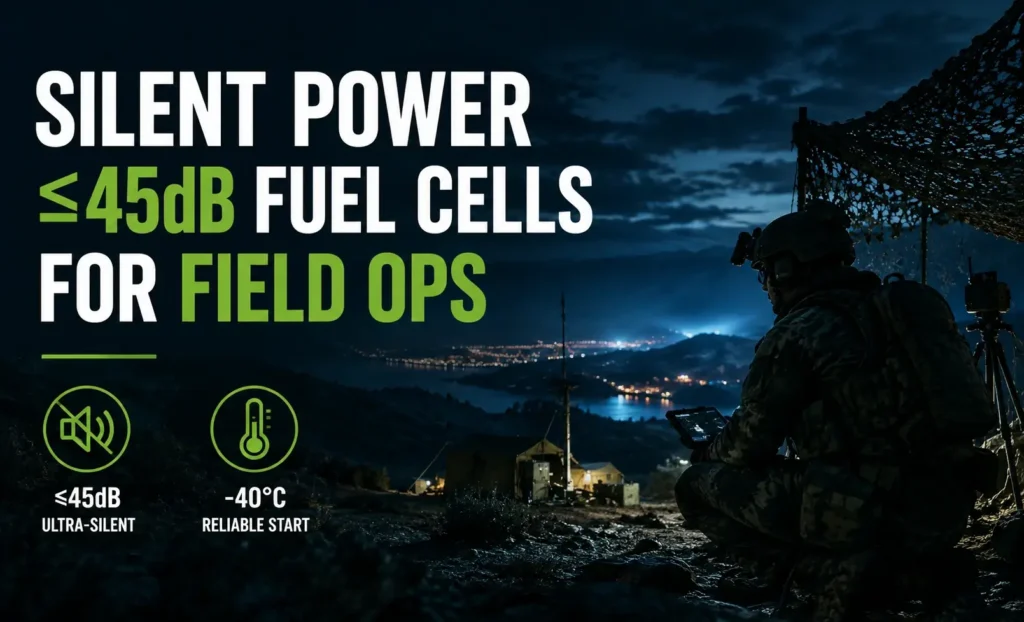
HYDRA‑M and HYDRA‑R offer a fundamentally different approach: ≤45dB operating noise, near‑zero thermal radiation, and -40°C reliable start.
This is not a quieter generator — this is acoustically and thermally near‑invisible power.
The Acoustic Signature Problem
In tactical environments, acoustic exposure is one of the most overlooked yet most dangerous signature management vulnerabilities.
Sound travels at 343 metres per second. In open terrain, a 70dB noise source can be detected 500 metres away — and even further in quiet conditions.
Forward observation posts require continuous power for radar, thermal imaging, and communications equipment. Running a diesel generator means:
- Acoustic exposure — engine noise can be locked onto by directional microphones or acoustic sensor arrays
- Thermal exposure — exhaust heat radiates like a beacon on thermal imaging equipment
- Operational interference — noise disrupts voice communications and degrades acoustic sensor accuracy
The presence of a diesel generator is itself an operational risk.
HYDRA‑M vs HYDRA‑R: Two Silent, Low‑Thermal Solutions
SOLIDHYDRO offers two silent tactical power solutions, sharing core tactical advantages while differing in fuel logistics.
Shared Advantages: ≤45dB + Near‑Zero Thermal Radiation
| Attribute | Performance | Operational Value |
|---|---|---|
| Operating noise | ≤45dB | Comparable to a quiet library — barely perceptible to the human ear beyond 50 metres |
| Thermal radiation | Near‑zero | PEMFC operates at low temperature (<80°C) — thermal signature is nearly undetectable by infrared sensors |
| no combustion, no moving mechanical parts, minimal explosion risk | Inherently quiet | No piston motion, no exhaust pulses, no vibration transmission |
HYDRA‑M: Intrinsically Safe Solid‑State Storage
Best for: High‑value special missions, extreme cold environments, zero‑pressure safety requirements
- Storage method: Solid‑state metal hydride, ambient‑pressure storage — no high‑pressure explosion risk
- Energy density: >1200Wh/kg — 3–5× that of lithium batteries
- Fuel replenishment: <60 seconds cartridge swap
- Cold‑weather performance: -40°C reliable start
- Supply chain: Requires dedicated solid‑state metal hydride cartridge supply
- Thermal signature: Near‑zero — PEMFC stack operates at low temperature, thermal signal is nearly undetectable
→ Explore HYDRA‑M full specifications
HYDRA‑R: Globally Deployable Methanol Reforming
Best for: Long‑duration surveillance, cost‑sensitive deployments, missions in any country worldwide
HYDRA‑R is fundamentally different from the direct methanol fuel cells (DMFC) commonly seen in the portable power market:
- Core technology: Reform first, generate later — methanol is converted into hydrogen‑rich gas before being fed to the HT‑PEMFC stack
- No methanol crossover: DMFC feeds liquid methanol directly into the stack, allowing methanol molecules to cross the proton exchange membrane and poison the platinum catalyst — generating parasitic current and causing real‑world efficiency far below theoretical values, with limited stack life
- No catalyst poisoning: The stack receives hydrogen‑rich gas, not methanol — fundamentally avoiding DMFC’s core limitations
| Comparison Dimension | DMFC (Direct Methanol) | HYDRA‑R (Methanol Reforming) |
|---|---|---|
| Stack fuel | Liquid methanol (direct injection) | Hydrogen‑rich gas (post‑reforming) |
| Methanol crossover | ❌ Severe, unavoidable | ✅ Non‑existent |
| Catalyst poisoning | ❌ Methanol poisons platinum catalyst | ✅ Non‑existent |
| Real‑world efficiency | Far below theoretical | 40–46% |
| Stack life | Limited (40% degradation at 3,000h) | Significantly longer |
| Fuel cost | High (proprietary cartridges) | ¼ of gasoline |
Fuel cost is ¼ that of gasoline — methanol is a globally traded commodity, available in virtually every country, with no dependency on specialised supply chains. The 50% methanol‑water mixture has significantly reduced flammability compared to pure methanol, enhancing transport and storage safety.
→ Explore HYDRA‑R full specifications
How to Choose: HYDRA‑M vs HYDRA‑R
| If your priority is… | Choose |
|---|---|
| Maximum safety (zero‑pressure) + extreme cold (-40°C) + high‑value special missions | HYDRA‑M |
| Lowest fuel cost (¼ of gasoline) + global deployability (resupply anywhere) + long‑duration surveillance | HYDRA‑R |
Many operations use both: HYDRA‑M for high‑value missions, HYDRA‑R for routine patrols and long‑duration surveillance — optimising cost and capability across the force.
Operational Scenarios
72‑Hour Silent Watch
Requirement: Forward observation post needs 72 hours of continuous power for radar, thermal imaging, and communications Challenge: Power source must not emit any detectable acoustic or thermal signature
HYDRA‑M:
- ≤45dB operating noise — acoustically near‑invisible
- Near‑zero thermal radiation — thermally near‑invisible
- One 1.35kg cartridge provides 27 hours of continuous runtime
- Three cartridges cover a full 72‑hour mission cycle
- Total carried weight ~9.5kg — far lighter than lithium‑based alternatives
Electronic Warfare Support
Requirement: Continuous power for electronic warfare platforms without thermal‑acoustic cross‑exposure Challenge: Thermal radiation reveals position; acoustic signature interferes with sensitive EW equipment
HYDRA‑M + HYDRA‑R:
- No thermal exposure risk — PEMFC thermal signature is minimal
- No mechanical vibration — does not interfere with precision electronics
- HYDRA‑R’s methanol can be sourced locally — no waiting for specialised fuel cartridge deliveries
Forward Medical Facility
Requirement: Continuous power for surgical lights, patient monitors, and communication equipment Challenge: Generator noise interferes with medical work; exhaust emissions threaten patient health
HYDRA‑R:
- ≤45dB — below operating room background noise standards
- Zero diesel emissions — suitable for ventilated tent environments
- Cartridge swap without shutdown — surgical procedures continue uninterrupted
- Methanol available globally — no dependency on specialised fuel supply chains
- Fuel cost is ¼ of gasoline — reducing logistical burden
Urban Environment Operations
Requirement: Covert deployment in urban peacekeeping or law enforcement operations Challenge: Noise disturbs civilians, reveals operations, and creates panic
HYDRA‑M / HYDRA‑R:
- ≤45dB — below urban nighttime ambient noise levels
- No exhaust emissions — safe for indoor operation
- No detectable thermal radiation — does not trigger infrared perimeter sensors
- HYDRA‑R’s methanol can be sourced locally — no dedicated resupply required
Multi‑Signature Management
Modern operations require management of four signature dimensions:
| Signature Dimension | Diesel Generator | Lithium Battery | HYDRA‑M | HYDRA‑R |
|---|---|---|---|---|
| Acoustic | High (70–85dB) | Low | ≤45dB | ≤45dB |
| Infrared | High (exhaust heat) | Low | Near‑zero | Near‑zero |
| Electromagnetic | Moderate (motor brushes) | Low | Low (depends on supporting equipment) | Low (depends on supporting equipment) |
| Visual | High (large footprint) | Moderate | Compact | Compact |
HYDRA‑M and HYDRA‑R achieve extremely low signatures in both acoustic and infrared dimensions. Electromagnetic signature depends on associated power electronics — SOLIDHYDRO offers low‑EMI configurations upon request. Visual signature depends on camouflage and deployment — but the compact form factor makes concealment significantly easier.
Comparison Table: Silent Power Options
| Dimension | Diesel Generator | Lithium Battery | HYDRA‑M | HYDRA‑R |
|---|---|---|---|---|
| Operating noise | 70–85dB | 0dB (static) | ≤45dB | ≤45dB |
| Thermal radiation | High | Low | Near‑zero | Near‑zero |
| Continuous runtime | Fuel‑dependent | Hours | 27h/cartridge | Weeks/months |
| Fuel cost | High (+logistics premium) | Moderate (charging) | Specialised supply | ¼ of gasoline |
| Fuel availability | Requires delivery | Requires grid/charger | Requires dedicated supply | Globally traded commodity |
| Mission type | Base‑level | Short‑duration tactical | Special operations | Long‑duration / cost‑sensitive |
Conclusion: Invisible Power for Modern Operations
In modern operations, “being heard” and “being detected” are equally unacceptable.
Diesel generators reveal position through noise and thermal radiation. Lithium batteries limit mission duration through energy density. DMFC sacrifices efficiency and longevity for simplicity.
HYDRA‑M and HYDRA‑R offer a different answer:
- ≤45dB silent operation — acoustically near‑invisible
- Near‑zero thermal radiation — infrared near‑invisible
- -40°C reliable start — unfazed by extreme environments
- Rapid fuel cartridge replacement — <60 seconds (HYDRA‑M) or 5–10 minutes (HYDRA‑R)
- Two complementary technologies — HYDRA‑M (maximum safety) and HYDRA‑R (low cost + global deployability)
HYDRA‑M and HYDRA‑R transform power from a source of exposure — into energy that is acoustically and thermally near‑invisible.
FQA:
Q: Why are silent fuel cells important for tactical operations?
A: In tactical and remote field environments, low acoustic and thermal signatures can help reduce the detectability of power equipment. HYDRA-M operates at ≤45 dB, providing a quieter alternative to conventional diesel generators for noise-sensitive applications.
Q: How quiet is HYDRA-M compared with diesel generators?
A: HYDRA-M operates at ≤45 dB, significantly reducing the mechanical and exhaust noise associated with conventional combustion generators. Its quiet operation makes it suitable for forward field operations, remote communications, observation equipment, and other noise-sensitive applications.
Q: What causes thermal signature in portable power systems?
A: Thermal signature is primarily generated by waste heat from power conversion, cooling, and exhaust systems. HYDRA-M uses a low-temperature PEM fuel-cell system operating below 80°C, helping reduce concentrated waste heat compared with conventional combustion-based power generation.
Q: Can fuel cells replace diesel generators in field operations?
A: Yes. Fuel cells can replace diesel generators in many portable and remote power applications where low noise, zero operational emissions, reliability, and reduced maintenance are important. HYDRA-M delivers ≤45 dB operation and -40°C cold-start capability, making it suitable for demanding field-power applications.
Continue reading:
- One Person, One Canister, 5 Min‑ RMFC Off-Grid Power
- Explore HYDRA‑M Solid‑State Metal Hydride Tactical Power
- Explore HYDRA‑R Methanol Reforming Tactical Power
- View tactical power solutions
- 60W Man‑Portable Power: Sizing Guide for Field Operations
- Ambient‑Pressure Safety: Solid‑State Metal Hydride for Field Power
- View All Blog Posts